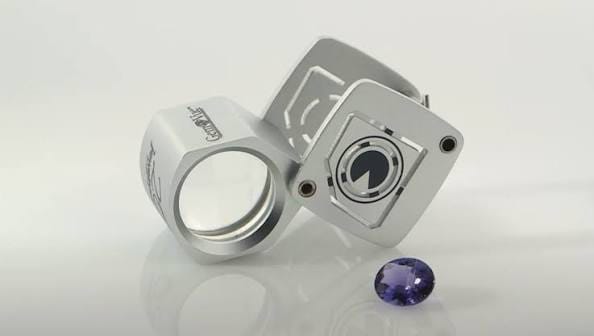
Using a Jeweler’s Loupe
Triplet loupes contain three lenses and are often considered to be of better quality than those loupes that contain only one. These single lens loupes often distort the objects that are being magnified and have been known to add extra flashes of color that cannot directly be attributed to the stone. These extra flashes can be especially deceiving when trying to determine the quality of a diamond. The three lenses in a triplet loupe are arranged in such a way that distortions and additional flashes are eliminated.When holding a loupe, many professionals recommend a technique that places your index finger through the "loop" produced by the lens case once the loupe is opened. Then, resting your hand on your cheek, bring the stone towards (or away from) the loupe to focus. This technique maximizes the stability of your grip and allows you to concentrate more on the details of your stone.Once you have established a stable grip and have focused your stone accordingly, begin your search for characteristics in a systematic fashion. Look closely for cracks, chips, or inclusions that might affect the value of your stone. Additionally, pay close attention to the overall workmanship of the jewelry it is mounted in to ensure your overall satisfaction of the piece. Feel free to ask questions; Whiteflash is always happy to assist you.These tips are a great place to start learning more about diamonds and gemstones in general. Practice slow, methodical investigation and you'll soon be grading stones like an expert!
Jeweler’s Loupe Guide: How to Examine Diamonds and Gemstones Like a Professional
A jeweler’s loupe is one of the most essential tools in gemology. Whether you are examining a diamond, identifying inclusions in a sapphire, or checking the craftsmanship of a piece of jewelry, this small magnifying instrument allows you to see details that are difficult or impossible to detect with the naked eye.
Understanding how to choose and use a jeweler’s loupe can help gemstone enthusiasts, collectors, and jewelry buyers make more informed decisions.
In this guide, we explore the different types of jewelry loupes, why triplet lenses are preferred by many professionals, and how to examine gemstones using proper magnification techniques.
What Is a Jeweler’s Loupe?
A jeweler’s loupe is a compact magnifying lens designed for close examination of gemstones, diamonds, precious metals, and jewelry.
Unlike ordinary magnifying glasses, high-quality jewelry loupes are designed to provide a clear, detailed view of small objects.
Gemologists, diamond graders, jewelers, and gemstone dealers use loupes to inspect characteristics such as:
- Internal inclusions and natural features
- Surface scratches, chips, and fractures
- Facet alignment and polishing quality
- Gemstone clarity characteristics
- Jewelry settings and craftsmanship
- Possible signs of gemstone treatments
Although loupes are available in several magnification strengths, 10× magnification is the standard choice for many gemological examinations.
Types of Jeweler’s Loupes
Jeweler’s loupes are available in different optical designs. Two common categories are single-lens loupes and triplet loupes.
1. Single-Lens Loupes
A single-lens loupe uses one magnifying lens to enlarge an object.
These loupes are generally inexpensive and suitable for basic magnification tasks.
However, simple single-lens designs may produce optical imperfections, particularly around the edges of the viewing area.
Common limitations include:
- Image distortion near the edges
- Colored fringes caused by chromatic aberration
- Reduced image sharpness
- Less accurate viewing of fine gemstone details
Chromatic aberration occurs when different wavelengths of light focus at slightly different positions, producing unwanted color fringes.
These effects can make it more difficult to examine gemstones accurately.
2. Triplet Loupes
A triplet loupe contains three lens elements arranged to improve image clarity and reduce optical distortions.
High-quality triplet loupes are especially popular among professional gemologists and diamond graders.
The optical design helps correct two important problems:
Chromatic aberration: Unwanted colored fringes around objects.
Spherical aberration: Blurring caused by light rays focusing at different points.
A well-made triplet loupe provides a sharper and more reliable view of gemstone characteristics.
However, not every triplet loupe performs equally well. Lens quality, manufacturing precision, lighting, and correct focusing all influence the final image.
Why Is a 10× Triplet Loupe Recommended?
A 10× triplet loupe is widely regarded as a practical standard for gemstone examination.
It provides enough magnification to reveal many important details while remaining relatively easy to handle.
For diamond clarity grading, the internationally established convention is to evaluate relevant clarity characteristics at 10× magnification under standardized conditions.
Higher magnifications may reveal additional details, but they are not automatically better for routine examination.
A 10× triplet loupe offers a useful balance between magnification, optical clarity, and ease of use.
How to Use a Jeweler’s Loupe Correctly
Learning to use a loupe requires patience and practice. A stable hand position, proper lighting, and accurate focusing are essential.
Step 1: Hold the Loupe Securely
Open the loupe and hold it comfortably between your thumb and index finger.
Some jewelers place a finger through the opening formed by the folding lens case to improve their grip.
Position the loupe close to one eye.
Step 2: Stabilize Your Hand
Rest the hand holding the loupe against your cheek.
This helps reduce unwanted movement and keeps the magnifying lens steady.
A stable position makes it easier to observe small inclusions and other gemstone features.
Step 3: Bring the Gemstone Into Focus
Keep the loupe close to your eye and slowly move the gemstone toward or away from the lens.
Continue adjusting the distance until the image becomes sharp.
The correct working distance depends on the optical design and magnification of the loupe.
Avoid moving the loupe and gemstone excessively at the same time.
Step 4: Use Appropriate Lighting
Good lighting is essential for accurate gemstone observation.
A neutral white light source is useful for many general inspections.
Position the light so that it illuminates the gemstone without creating excessive glare.
Different lighting directions may reveal different internal or surface characteristics.
Step 5: Examine the Gemstone Systematically
Once the gemstone is clearly focused, inspect it in an organized manner.
Start with the overall appearance before moving to smaller details.
Rotate the gemstone gently and examine it from different angles.
Pay particular attention to the following characteristics:
Inclusions: Internal crystals, growth features, feathers, and other characteristics within the gemstone.
Fractures: Breaks or cracks that may influence appearance, durability, or value.
Chips: Small areas of damage, particularly around facet junctions, edges, and the girdle.
Surface condition: Scratches, abrasions, pits, and polishing marks.
Cut quality: Facet arrangement, symmetry, and visible workmanship.
Jewelry craftsmanship: Prongs, settings, solder joints, and other construction details.
A systematic inspection reduces the likelihood of overlooking important features.
How to Examine Diamonds With a Loupe
A jeweler’s loupe is especially useful for observing diamond clarity characteristics.
Begin by cleaning the diamond carefully using a suitable jewelry-cleaning method.
Hold the diamond securely with appropriate gemstone tweezers or examine it in its existing setting.
Position the loupe close to your eye and bring the diamond into focus.
Examine the diamond through the table, then rotate it to observe the crown, pavilion, and girdle where accessible.
Look for internal characteristics such as crystals, feathers, clouds, and pinpoints, as well as external features such as chips or abrasions.
Remember that a loupe examination alone cannot establish a reliable diamond clarity grade without appropriate training and standardized grading conditions.
Examining Colored Gemstones
Loupes are also valuable when inspecting colored gemstones such as sapphires, rubies, emeralds, and spinels.
Natural gemstones may contain internal characteristics related to their geological formation.
For example, some sapphires and rubies contain fine rutile needles, mineral crystals, or growth features.
Emeralds frequently contain distinctive internal inclusions.
These characteristics can provide useful clues during gemological examination.
However, identifying whether a gemstone is natural, synthetic, or treated may require additional instruments and laboratory testing.
A 10× loupe is an excellent starting tool, but it cannot confirm every gemstone's identity or treatment history.
Common Mistakes When Using a Jeweler’s Loupe
Beginners often make several avoidable mistakes.
Holding the loupe too far from the eye: This can make viewing more difficult and reduce the usable field of view.
Using insufficient lighting: Poor illumination can hide important details.
Examining a dirty gemstone: Dust, fingerprints, and surface residue can be mistaken for internal characteristics.
Moving both hands constantly: Excessive movement makes focusing difficult.
Relying only on magnification: Some gemstone features require specialized equipment to identify accurately.
Assuming every inclusion reduces value: The significance of an inclusion depends on the gemstone variety, its appearance, location, and other quality factors.
Developing a consistent examination technique is more important than rushing through the inspection.
How to Choose a Good Jeweler’s Loupe
When selecting a loupe for gemstone examination, consider optical quality rather than magnification alone.
A good loupe should offer:
- 10× magnification for routine gemological inspection
- A quality triplet optical design
- Good sharpness across the useful viewing area
- Minimal color fringing and distortion
- A comfortable, durable folding housing
- A lens size suitable for practical inspection
Professional-quality loupes may cost more than basic magnifiers, but their improved optical performance can make detailed examination easier.
Can a Jeweler’s Loupe Identify a Real Gemstone?
A jeweler’s loupe can reveal features that help gemologists investigate a gemstone, but it cannot independently guarantee authenticity.
For example, some inclusions may support an interpretation of natural origin, while certain manufacturing features may suggest a synthetic stone.
However, these observations are not always conclusive.
Professional gemstone identification may require refractometers, microscopes, spectroscopes, and other gemological instruments.
For valuable gemstones, an independent gemological laboratory report can provide additional confidence.
Jeweler’s Loupe Guide: 10 Essential Tips for Examining Gemstones
A jeweler’s loupe is an essential tool for examining diamonds, sapphires, rubies, and other precious gemstones. Here are 10 important tips for beginners.
1. Choose a 10× Magnification Loupe
A 10× loupe is the standard choice for routine gemstone examination. It provides enough magnification to observe many inclusions, fractures, and surface details.
2. Select a Triplet Loupe
A triplet loupe contains three lens elements designed to reduce optical distortion and unwanted color fringes, providing a clearer image than a basic single-lens loupe.
3. Hold the Loupe Close to Your Eye
Position the loupe comfortably near one eye while keeping the other eye relaxed. This helps maintain a clear viewing area.
4. Keep Your Hand Steady
Rest the hand holding the loupe against your cheek to minimize movement and improve focusing accuracy.
5. Adjust the Gemstone to Focus
Slowly move the gemstone toward or away from the loupe until its details appear sharp and clear.
6. Use Proper Lighting
Examine gemstones under suitable white lighting. Adjust the light direction to reveal internal features and minimize reflections.
7. Look for Internal Inclusions
Inspect the gemstone for crystals, needles, feathers, and other internal characteristics that may provide useful information about its formation.
8. Check for Surface Damage
Look carefully for scratches, chips, fractures, and abrasions, particularly around gemstone edges and facet junctions.
9. Examine the Cut and Polish
Observe the gemstone's facet alignment, symmetry, polish, and overall craftsmanship. These features influence its appearance and quality.
10. Rotate and Inspect From Different Angles
Turn the gemstone slowly to examine different areas. A systematic inspection helps reveal details that may not be visible from a single direction.
Final Thoughts
- 10× magnification for routine gemological inspection
- A quality triplet optical design
- Good sharpness across the useful viewing area
- Minimal color fringing and distortion
- A comfortable, durable folding housing
- A lens size suitable for practical inspection
A high-quality 10× triplet loupe is a valuable starting tool for anyone interested in gemology. With proper lighting, stable handling, and regular practice, you can develop better gemstone observation skills.
Remember that a loupe examination alone cannot confirm every gemstone's identity, treatment history, or value. Professional gemological testing may be necessary.
Final Thoughts
A jeweler’s loupe is a simple but powerful instrument that belongs in every gemstone enthusiast’s toolkit.
For most beginners and professionals, a high-quality 10× triplet loupe is a practical choice because it provides useful magnification while minimizing optical distortions.
Learning to hold the loupe steadily, focus correctly, use suitable lighting, and inspect gemstones systematically will improve your ability to recognize important details.
With regular practice, you can develop stronger gemstone observation skills and a deeper appreciation for the natural characteristics and craftsmanship that make each gemstone unique.
Whether you are buying your first sapphire or studying diamonds more seriously, mastering the jeweler’s loupe is an important step in your gemological journey.