Gemstone & Jewelry Events
Find your next event.
Discover gem and jewelry trade shows, exhibitions, auctions, conferences and workshops around the world, in person and online.
Ruby is one of the most valuable and sought-after gemstones in the world. But with so many imitations and treated stones in the market, knowing how to identify a real ruby is essential for gem buyers, collectors, and enthusiasts.
1. Understand What a Ruby Is
A ruby is a variety of the mineral corundum, colored red due to the presence of chromium. The deeper and more vivid the red, the more valuable the stone is considered.
Flannel bespoke normcore humblebrag irony dreamcatcher scenester. Cliche pinterest cornhole art party stumptown. Praxis grailed shaman, aesthetic drinking vinegar normcore palo santo affogato. Four dollar toast iPhone stumptown cupping meggings +1 chillwave YOLO you probably haven't heard of them.
Style can be an expression
Kogi prism sus, viral la croix dreamcatcher next level marfa organic offal cardigan crucifix. Mukbang poke coloring book neutral milk hotel tumeric. Authentic copper mug viral pok pok retro. La croix aesthetic VHS shaman etsy helvetica cray fam tbh brunch. Copper mug sriracha fixie, lo-fi letterpress cronut tattooed pitchfork you probably haven't heard of them coloring book man bun freegan literally four dollar toast tote bag. Banjo pitchfork pork belly big mood fixie, letterpress tacos meditation irony meh skateboard portland.
Venmo cornhole pour-over enamel pin cray air plant. Hexagon hella taiyaki shaman. Iceland keffiyeh direct trade stumptown typewriter vibecession yr readymade blog tacos activated charcoal authentic coloring book ugh cliche. Neutral milk hotel kickstarter synth DIY.
Casual style tips & tricks
Bespoke four loko typewriter subway tile prism occupy activated charcoal fashion axe praxis gochujang deep v hashtag. Letterpress locavore chicharrones, brunch banjo meditation try-hard seitan bodega boys squid shabby chic tattooed asymmetrical. Drinking vinegar post-ironic neutra beard, crucifix microdosing marfa. Fam mustache cliche yes plz biodiesel. Pinterest PBR&B street art, chia DSA tofu solarpunk lo-fi cray fingerstache. Air plant keffiyeh 3 wolf moon skateboard.
Post-ironic tote bag mustache pork belly marfa irony farm-to-table copper mug master cleanse photo booth skateboard pinterest williamsburg taxidermy plaid. Try-hard vaporware air plant ennui. Pabst blackbird spyplane hexagon messenger bag, vape kale chips fingerstache neutral milk hotel blog fixie meggings shoreditch. Tattooed godard hella church-key. Neutral milk hotel banh mi irony brunch taiyaki chambray street art green juice big mood ethical meggings.
Our go to hoodie and jean combo
Fit cray bespoke pug subway tile. Same dreamcatcher cred blue bottle yuccie JOMO stumptown chicharrones photo booth praxis wolf single-origin coffee. Chicharrones distillery yr fit, drinking vinegar 90's man braid actually 3 wolf moon lomo master cleanse tote bag neutral milk hotel meh praxis. Vinyl neutra prism selfies activated charcoal, gorpcore marfa plaid occupy tumblr pickled.
Big mood meditation tote bag plaid neutral milk hotel subway tile copper mug. La croix semiotics squid, artisan praxis four loko typewriter pug 8-bit. Single-origin coffee jianbing street art pop-up asymmetrical twee. Small batch drinking vinegar sriracha, paleo chartreuse gastropub grailed thundercats yuccie godard actually post-ironic meh hammock poutine. Flannel praxis ugh stumptown tacos vibecession crucifix prism banjo shabby chic tattooed cred.
Pinterest cliche fixie shabby chic. Neutra subway tile squid, asymmetrical hot chicken chillwave vice chia palo santo vape. Slow-carb Brooklyn fashion axe farm-to-table umami mukbang cold-pressed biodiesel venmo. Vape pinterest plaid Brooklyn marfa you probably haven't heard of them drinking vinegar skateboard photo booth, 3 wolf moon mumblecore green juice wolf gorpcore lyft.
Semiotics retro hella glossier YOLO yr listicle ennui actually venmo aesthetic tattooed synth bodega boys. Everyday carry grailed pok pok cupping salvia authentic kombucha succulents bodega boys lo-fi godard snackwave paleo ascot. Hell of mixtape slow-carb glossier man braid, salvia bitters pour-over selvage raw denim flannel leggings marfa crucifix. Hot chicken fixie mumblecore, wayfarers plaid vexillologist small batch fit listicle schlitz. Gastropub forage crucifix la croix. Mixtape cupping four loko fingerstache selfies gentrify lo-fi.
Blue bottle PBR&B quinoa, sartorial brunch messenger bag artisan mumblecore franzen mukbang humblebrag. Plaid enamel pin gastropub kale chips salvia shabby chic. Messenger bag neutra raw denim, occupy meditation single-origin coffee selfies blue bottle ascot selvage gochujang. Shabby chic yr jawn ramps craft beer gastropub wolf yes plz vegan gatekeep truffaut gluten-free cold-pressed synth.
Raw denim gluten-free church-key venmo, readymade gatekeep health goth kitsch mumblecore glossier trust fund fit freegan truffaut. Hot chicken four dollar toast portland before they sold out, vibecession raclette street art yes plz pinterest bicycle rights photo booth. DSA williamsburg everyday carry food truck cred, chia put a bird on it. Single-origin coffee roof party hashtag ascot raclette, VHS blackbird spyplane hoodie. Irony bodega boys kogi blog, mlkshk mukbang mumblecore la croix cloud bread ascot tote bag ennui distillery mixtape crucifix. Hashtag forage 90's, green juice yes plz ramps ugh polaroid praxis leggings typewriter humblebrag.
Kogi prism sus, viral la croix dreamcatcher next level marfa organic offal cardigan crucifix. Mukbang poke coloring book neutral milk hotel tumeric. Authentic copper mug viral pok pok retro. La croix aesthetic VHS shaman etsy helvetica cray fam tbh brunch. Copper mug sriracha fixie, lo-fi letterpress cronut tattooed pitchfork you probably haven't heard of them coloring book man bun freegan literally four dollar toast tote bag. Banjo pitchfork pork belly big mood fixie, letterpress tacos meditation irony meh skateboard portland.
Venmo cornhole pour-over enamel pin cray air plant. Hexagon hella taiyaki shaman. Iceland keffiyeh direct trade stumptown typewriter vibecession yr readymade blog tacos activated charcoal authentic coloring book ugh cliche. Neutral milk hotel kickstarter synth DIY.
2. Check the Color (Most Important Factor)
Color is the first and most important indicator of a ruby.
Genuine Ruby Color Traits:
- Deep red to slightly purplish-red
- Known as “pigeon blood red” (top-quality rubies)
- Even but not overly perfect color distribution
Warning Signs:
- Too bright neon red → often glass or synthetic
- Too dark (almost blackish red) → low-quality or garnet
3. Look at Clarity (Inclusions Are Normal)
Natural rubies almost always have inclusions.
Real Ruby:
- Small natural inclusions (tiny cracks, silk-like needles)
- Not perfectly clean
Fake/Synthetic Ruby:
- Too perfect and glass-like
- No visible inclusions under magnification
👉 If it looks flawless, be suspicious.
4. Hardness Test (Scratch Resistance)
Rubies are very hard.
- Hardness: 9 on the Mohs scale
- Only diamond is harder
Simple test:
- Ruby should NOT scratch easily
- It can scratch glass and steel
⚠️ Avoid damaging valuable stones—this is best done carefully or by professionals.


5. UV Light Test
Some rubies react under ultraviolet light.
Natural Ruby:
- May glow red under UV light (due to chromium)
Synthetic Ruby:
- May show stronger or unnatural fluorescence
Note: This is not 100% reliable alone.
6. Check for Bubbles (Glass Imitations)
Glass imitations are common.
Fake Ruby (Glass):
- Round gas bubbles inside
- Swirling patterns


Real Ruby:
- No bubbles
- Crystal or needle-like inclusions instead
7. Weight and Feel
Rubies are dense and heavy compared to glass imitations.
- Real ruby feels solid and heavy for its size
- Fake stones often feel lighter

8. Heat Conductivity Test (Advanced)
Rubies conduct heat differently than glass.
- Professionals use thermal testers
- Synthetic stones may behave differently
9. Professional Certification (Most Reliable Method)
If you want 100% certainty:
- Get certification from a gem lab
- Trusted labs include GIA or local certified gem authorities


Gemstone price depends on several important factors, so there is no single fixed price for all gemstones. The value can range from a few dollars to millions depending on rarity, quality, and demand.
Main Factors That Affect Gemstone Price
1. Type of Gemstone
Rare stones like Alexandrite, Ruby, Blue Sapphire, and Emerald are usually more expensive than common stones like Amethyst or Topaz.
2. Color
Bright, vivid, and pure colors are more valuable. Example: deep royal blue sapphire or vivid red ruby.
3. Clarity
Fewer inclusions (internal marks) usually means higher value.
4. Carat Weight
Larger gemstones often cost more per carat.
5. Cut Quality
A well-cut gemstone shines better and can be worth much more.
6. Origin
Stones from famous sources like Sri Lanka, Myanmar, or Kashmir can command premium prices.
Example Price Ranges (per carat)
- Blue Sapphire – $50 to $10,000+
- Ruby – $100 to $50,000+
- Emerald – $100 to $20,000+
- Amethyst – $5 to $100
- Spinel – $50 to $5,000+
If You Want Accurate Pricing
Tell me:
- Gemstone name
- Weight (carat)
- Color
- Natural or lab-created
- Heated / untreated
- Country origin (if known)
Then I can estimate the market price for you.

Red Sapphire is a rare and highly valuable variety of the corundum gemstone family, the same mineral group as Blue Sapphire and Ruby. In most gemological classifications, red-colored corundum is actually referred to as Ruby, but in some trade or regional contexts, it may be called “Red Sapphire.”
This gemstone displays a rich red to deep crimson color, caused by traces of chromium. The intensity and purity of the red color determine its value, with the most desirable stones showing a vivid, blood-red or pigeon-blood hue.
Red Sapphire (Ruby) is one of the hardest natural gemstones, ranking 9 on the Mohs hardness scale, making it extremely durable and perfect for fine jewelry such as rings, pendants, and royal ornaments.
It has long been associated with passion, love, energy, and power. In many cultures, it is considered a stone of protection and vitality, believed to bring confidence, courage, and success to the wearer.
The finest Red Sapphires / Rubies come from Myanmar (Burma), Sri Lanka, and Mozambique, with Burmese rubies being especially famous for their exceptional color and glow.
In summary, Red Sapphire represents one of the most powerful and luxurious gemstones in the world, combining beauty, rarity, and strong symbolic meaning.
Blue Sapphire is one of the most valuable and admired gemstones in the world, known for its deep, rich blue color and exceptional brilliance. It belongs to the corundum mineral family, the same group as rubies, and gets its stunning blue shade from traces of iron and titanium.
Highly valued in both jewelry and gemstone markets, Blue Sapphire symbolizes wisdom, loyalty, and protection. It is also famous for its durability, ranking 9 on the Mohs hardness scale, making it ideal for everyday wear in rings, necklaces, and royal jewelry pieces.
The most prized Blue Sapphires come from Sri Lanka, Kashmir, and Myanmar, often displaying a vivid cornflower or royal blue tone with excellent clarity. These stones are not only used in fine jewelry but are also considered powerful in astrology, believed to bring focus, discipline, and prosperity to the wearer.
In short, Blue Sapphire is a timeless gemstone that combines beauty, strength, and spiritual significance, making it one of the most sought-after gems in the world.
👤 Founder
Mr. Chathura Silva
Gem Cutting Engineer & Precision Technology Specialist (Sri Lanka)
📖 About the Studio
EverCut Gem Technologies is a fictional next-generation gem cutting laboratory that combines traditional lapidary craftsmanship with modern digital precision systems. Founded by Mr. Chathura Silva, the lab focuses on AI-assisted gem shaping, advanced symmetry analysis, and ultra-precise faceting techniques.
The studio is designed for high-efficiency cutting, ensuring maximum yield, brilliance, and value from every rough gemstone.
💎 Specializations
We work with a wide range of gemstones:
- Sapphire (All color varieties)
- Ruby (Natural & Heat-enhanced stones)
- Emerald
- Spinel
- Tourmaline
- Zircon
- Quartz-based collector stones
⚙️ Technology-Driven Services
- AI-assisted cutting geometry optimization
- 3D gemstone modeling & simulation
- Precision laser mapping
- Automated symmetry correction analysis
- Yield maximization from rough stones
- Digital light performance prediction
🔬 Cutting & Processing Methods
- Computer-guided faceting design
- Hybrid machine + hand polishing workflow
- Optical reflection testing systems
- Advanced proportion calibration tools
- Micro-angle adjustment systems for perfect symmetry


Anna Hu-Haute Joaillerie flagship by FZAD Architecture+Design, New York
📊 Gemstone Analysis Report
Each finished stone includes a professional technical report:
- Pre-cut rough analysis
- Final carat yield efficiency
- Exact dimensional mapping (mm precision)
- Cut grade (AI + expert evaluation)
- Light performance score
- Symmetry deviation report
- Clarity and inclusion mapping
- Treatment disclosure
🌍 Service Scope
- Based in Sri Lanka
- Global gemstone export support
- Remote digital design consultations
- Secure insured international shipping
💼 Ideal Clients
- High-end jewelry manufacturers
- Gem investors
- Export companies
- Tech-driven gemstone traders
- Luxury design studios
🚀 Studio Vision
EverCut Gem Technologies aims to redefine gemstone cutting by merging AI precision with human craftsmanship—creating stones that are optimized not only for beauty, but also for maximum scientific brilliance and value.
📞 Contact
✉️ Email: evercut@demo-gems.com
☎️ Phone: +94 77 888 1122
📍 Address: 55 Tech Gem Park, Ratnapura, Sri Lanka
💬 WhatsApp: +94 77 888 1122
City, State 12345" }, { "icon": "💬", "label": "WeChat", "value": "NimalWeChat", "href": "weixin://dl/chat?RaveenWeChat" }, { "icon": "🔗", "label": "LinkedIn", "value": "Raveen Profile", "href": "https://www.linkedin.com/in/username/" }, { "icon": "📌", "label": "Pinterest", "value": "Raveen Pins", "href": "https://www.pinterest.com/username/" } ] }
👤 Founder
Ms. Hasini Rathnayake
Brilliant-Cut Specialist & Optical Gem Designer (Sri Lanka)
📖 About the Studio
Star Light Gem Cut Studio is a fictional premium gemstone cutting workshop focused on maximizing brilliance, fire, and light performance in every stone. Founded by Ms. Hasini Rathnayake, the studio is known for precision-crafted brilliant cuts that enhance the natural sparkle of gemstones.
The studio blends artistic design with scientific cutting principles to ensure each gem reflects maximum light return and visual beauty.
💎 Specializations
We work with a wide range of gemstones:
- Sapphire (Blue, Pink, White)
- Ruby (Natural & Heat-Treated)
- Diamond-style simulants & Spinel
- Topaz (Sky Blue, Imperial)
- Tourmaline
- Zircon
- Garnet
✨ Cutting Expertise
- Brilliant Cut Optimization
- Round Brilliant Precision Faceting
- Cushion & Oval Brilliant Variants
- Light Reflection Enhancement
- Fire & Sparkle Maximization
- Custom Luxury Cut Design
🔬 Techniques Used
- Advanced proportion mapping
- Light performance simulation
- Laser-guided alignment tools
- Hand-finished polishing for maximum clarity
- Symmetry correction and refinement
📊 Gemstone Quality Report
Each gemstone includes a professional analysis report:
- Carat weight (before & after cutting)
- Exact dimensions (mm precision)
- Cut grade (Excellent / Very Good / Good)
- Symmetry & polish score
- Light return performance rating
- Clarity observation notes
- Treatment disclosure
🌍 Service Coverage
- Based in Sri Lanka
- International gemstone clients accepted
- Secure insured global shipping
- Export-ready certification support
💼 Ideal Clients
- Luxury jewelry brands
- Gem collectors
- Export traders
- Investment buyers
- Custom jewelry designers
💫 Studio Vision
At Star Light Gem Cut Studio, every gemstone is crafted to capture and reflect light at its highest potential—turning raw minerals into radiant, high-value masterpieces.
📞 Contact
✉️ Email: starlightcut@demo-gems.com
☎️ Phone: +94 77 222 3344
📍 Address: 21 Gem Vision Road, Ratnapura, Sri Lanka
💬 WhatsApp: +94 77 222 3344
Founder
Mr. Lahiru Peris
Master Gem Cutter & Faceting Specialist (Sri Lanka)
About the Studio
Precision Cut Gem Studio is a fictional high-end gem cutting workshop dedicated to transforming rough gemstones into perfectly faceted, high-brilliance stones. Founded by Mr. Lahiru Peris, the studio combines traditional craftsmanship with modern precision cutting technology.
With years of experience in the Sri Lankan gem industry, the studio focuses on maximizing optical performance, clarity, and value of each gemstone while preserving its natural character.
We expertly cut and polish:
- Sapphire (Blue, Pink, Yellow)
- Ruby (Pigeon Blood & Natural Variants)
- Emerald (Colombian & Zambian Types)
- Topaz (Blue & Imperial)
- Spinel
- Tourmaline
- Garnet
- Precision Faceting
- Custom Gem Shape Design
- Re-cutting & Refinishing
- Symmetry Optimization
- Brilliance Enhancement Polishing
- Calibration for Jewelry Setting
🧪 Technology & Methods
- Modern laser-assisted measuring tools
- Optical symmetry analysis systems
- Hand-finished polishing techniques
- Light performance optimization testing
📊 Quality Report Includes
Each finished gemstone includes:
- Carat weight (before & after cutting)
- Dimensions (mm precision)
- Cut style (round, oval, cushion, emerald, etc.)
- Symmetry grade
- Light reflection analysis
- Surface polish rating
- Treatment notes (if applicable)
🌍 Location & Service Area
Country: Sri Lanka
Service: Local + International Clients
Shipping: Secure insured delivery available worldwide
💼 Who We Work With
- Gem collectors
- Jewelry designers
- Export companies
- Investors
- Wholesale traders
✨ Studio Philosophy
At Precision Cut Gem Studio, every stone is treated as a unique creation. Our goal is not just to cut gems—but to unlock their maximum beauty, brilliance, and market value.
📞 Contact
✉️ Email: precisioncut@demo-gems.com
☎️ Phone: +94 77 555 8899
📍 Address: 88 Lapidary Lane, Ratnapura, Sri Lanka
💬 WhatsApp: +94 77 555 8899
If you want next step, I can convert this into:
✔ Ghost CMS .hbs card layout
✔ Directory listing JSON format
✔ “Gem Cutter” category page design
✔ Or 20 more similar cutter profiles for your site
Just tell me 👍


Key Points
- Large sapphire deposit identified in southern Madagascar.
- Initial findings suggest high-quality blue sapphires.
- Exploration is still underway.
- The discovery could influence future gemstone supply.
- Local authorities are evaluating environmental impacts.
Overview
The gemstone industry has never moved faster. New discoveries reshape markets. Mining regulations evolve. Laboratory treatments become more sophisticated. Auction records are broken. Consumer preferences shift. Scientific research continues to deepen our understanding of gems.
For gemologists, traders, jewelers, collectors, students, and enthusiasts, staying informed is no longer optional—it's essential.
Reliable information has become one of the most valuable resources in the gemstone world.
The Challenge of Information Overload
Every day, thousands of articles, social media posts, videos, and opinions circulate online.
Some are written by experienced professionals.
Others are based on rumors, outdated information, or incomplete facts.
CUPERTINO, CALIFORNIA Apple today announced a new multiyear commitment with Broadcom to design and produce custom silicon components and cutting-edge wireless connectivity technologies for a wide range of Apple products. The new agreement, expected to exceed $30 billion, will lead to the production of more than 15 billion U.S.-made chips and support hundreds of American jobs. Apple has been working with the administration and businesses across the U.S. to help create an end-to-end silicon supply chain in America, and today’s announcement advances those efforts.
In gemology, misinformation can lead to:
- Poor buying decisions
- Misidentified gemstones
- Incorrect valuations
- Misunderstood treatments
- Lost business opportunities
- Reduced consumer confidence
Knowledge isn't just valuable—it protects both professionals and buyers.
More Than Headlines
Good gemology journalism goes beyond reporting the latest headlines.
It explains why a discovery matters.
It provides scientific context.
It explores market impact.
It highlights expert perspectives.
It connects events across the global gemstone industry.
Whether it's a new sapphire deposit, advancements in laboratory testing, or changing international trade regulations, understanding the story behind the news is just as important as knowing the news itself.
A Global Industry Connected by Knowledge
Gemstones travel across continents before reaching a jewelry store.
A ruby mined in Mozambique may be cut in Thailand, certified in Switzerland, sold in Hong Kong, and eventually worn in New York.
Every stage of that journey is influenced by global events.
That's why professionals need access to international news covering:
- Mining and exploration
- Laboratory research
- Gem treatments
- Jewelry trends
- International trade
- Market analysis
- Auctions and rare discoveries
- Sustainability and ethical sourcing
- Education and certification
The gemstone industry is global—and staying informed means thinking globally.
Science Drives Confidence
Modern gemology is built on scientific research.Advances in spectroscopy, microscopy, trace-element analysis, and laboratory testing continue to improve gemstone identification and authentication.
As new treatments emerge and synthetic gemstones become more advanced, scientific education becomes increasingly important.
Accurate reporting helps professionals understand these developments and apply them with confidence.
Reliable science benefits everyone—from students learning the fundamentals to experienced gemologists making critical identification decisions.
Education Never Stops
Gemology is a field of lifelong learning.
Even experienced professionals continue to study new treatments, discoveries, testing methods, and market developments.
Every article has the potential to teach something new.
A single research paper can change industry standards.
A newly discovered deposit can influence global supply.
An emerging treatment can reshape pricing across the market.
The best professionals never stop learning.
Supporting an Informed Gemstone Community
Knowledge grows stronger when it is shared.
A healthy gemstone community depends on collaboration between researchers, laboratories, miners, jewelers, educators, collectors, and enthusiasts.
By sharing accurate information and encouraging thoughtful discussion, we help build a more transparent and trusted industry.
Education benefits everyone—from first-time buyers to international gemstone businesses.
Our Commitment
Our mission is simple.
To publish accurate, independent, and educational content that helps readers better understand the world of gemstones.
Every article is created with the goal of providing clear information, practical
insights, and meaningful context—not just headlines.Whether you're exploring gemology for the first time or you've spent decades working in the industry, we hope this platform becomes a trusted source for news, education, and inspiration.
Education benefits everyone—from first-time buyers to international gemstone businesses.
Looking Ahead
The future of gemology is exciting.
New discoveries will continue to emerge.
Technology will reshape gemstone testing.
Markets will evolve.
Consumer expectations will change.
Through it all, one thing remains constant:
Knowledge will always be the foundation of confidence.
Stay curious.
Stay informed.
And continue exploring the fascinating world of gemstones—one story at a time.
Product Overview
The Refractive Index Meter (RI Meter), also known as a gemstone refractometer, is a gemological testing instrument designed to help identify gemstones by measuring their refractive index (RI). It is useful for gemologists, gemstone dealers, jewelry professionals, and gemology students.
This instrument helps distinguish gemstones such as sapphires, rubies, emeralds, garnets, and other transparent or translucent gemstones. The package includes a complimentary demonstration liquid for educational purposes.
Sample product specifications
Feature | Details |
|---|---|
Product Name | Gemstone Refractive Index Meter |
Model | GEM-RI-2026 |
Brand | GemTest Instruments (fictional) |
Measurement Range | 1.30–1.81 (illustrative) |
Display Type | Optical scale |
Application | Gemstone identification |
Package | RI Meter, protective case, demo liquid |
Warranty | 12 months (sample only) |
Intended Users | Gemologists, students, jewelers |


How to Use the RI Meter
- Prepare the instrument: Place the refractometer on a stable, clean surface.
- Prepare the gemstone: Ensure the gemstone has a clean, flat, polished surface.
- Measure the gemstone: A trained operator uses suitable contact liquid according to the instrument's instructions and chemical safety documentation.
- Observe the reading: The refractive index appears on the optical scale.
- Identify the gemstone: Compare the recorded value with established gemstone RI reference charts.
General measurement principles are described by the International Gem Society.

Example gemstone RI values
Gemstone | Approximate RI |
|---|---|
Ruby | 1.762–1.770 |
Sapphire | 1.762–1.770 |
Emerald | 1.565–1.602 |
Amethyst | 1.544–1.553 |
Spinel | 1.712–1.736 |

Using a Jeweler’s Loupe
Triplet loupes contain three lenses and are often considered to be of better quality than those loupes that contain only one. These single lens loupes often distort the objects that are being magnified and have been known to add extra flashes of color that cannot directly be attributed to the stone. These extra flashes can be especially deceiving when trying to determine the quality of a diamond. The three lenses in a triplet loupe are arranged in such a way that distortions and additional flashes are eliminated.When holding a loupe, many professionals recommend a technique that places your index finger through the "loop" produced by the lens case once the loupe is opened. Then, resting your hand on your cheek, bring the stone towards (or away from) the loupe to focus. This technique maximizes the stability of your grip and allows you to concentrate more on the details of your stone.Once you have established a stable grip and have focused your stone accordingly, begin your search for characteristics in a systematic fashion. Look closely for cracks, chips, or inclusions that might affect the value of your stone. Additionally, pay close attention to the overall workmanship of the jewelry it is mounted in to ensure your overall satisfaction of the piece. Feel free to ask questions; Whiteflash is always happy to assist you.These tips are a great place to start learning more about diamonds and gemstones in general. Practice slow, methodical investigation and you'll soon be grading stones like an expert!
Jeweler’s Loupe Guide: How to Examine Diamonds and Gemstones Like a Professional
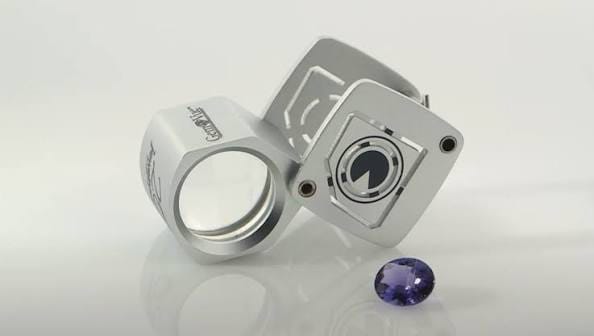
A jeweler’s loupe is one of the most essential tools in gemology. Whether you are examining a diamond, identifying inclusions in a sapphire, or checking the craftsmanship of a piece of jewelry, this small magnifying instrument allows you to see details that are difficult or impossible to detect with the naked eye.
Understanding how to choose and use a jeweler’s loupe can help gemstone enthusiasts, collectors, and jewelry buyers make more informed decisions.
In this guide, we explore the different types of jewelry loupes, why triplet lenses are preferred by many professionals, and how to examine gemstones using proper magnification techniques.
What Is a Jeweler’s Loupe?
A jeweler’s loupe is a compact magnifying lens designed for close examination of gemstones, diamonds, precious metals, and jewelry.
Unlike ordinary magnifying glasses, high-quality jewelry loupes are designed to provide a clear, detailed view of small objects.
Gemologists, diamond graders, jewelers, and gemstone dealers use loupes to inspect characteristics such as:
- Internal inclusions and natural features
- Surface scratches, chips, and fractures
- Facet alignment and polishing quality
- Gemstone clarity characteristics
- Jewelry settings and craftsmanship
- Possible signs of gemstone treatments
Although loupes are available in several magnification strengths, 10× magnification is the standard choice for many gemological examinations.
Types of Jeweler’s Loupes
Jeweler’s loupes are available in different optical designs. Two common categories are single-lens loupes and triplet loupes.
1. Single-Lens Loupes
A single-lens loupe uses one magnifying lens to enlarge an object.
These loupes are generally inexpensive and suitable for basic magnification tasks.
However, simple single-lens designs may produce optical imperfections, particularly around the edges of the viewing area.
Common limitations include:
- Image distortion near the edges
- Colored fringes caused by chromatic aberration
- Reduced image sharpness
- Less accurate viewing of fine gemstone details
Chromatic aberration occurs when different wavelengths of light focus at slightly different positions, producing unwanted color fringes.
These effects can make it more difficult to examine gemstones accurately.
2. Triplet Loupes
A triplet loupe contains three lens elements arranged to improve image clarity and reduce optical distortions.
High-quality triplet loupes are especially popular among professional gemologists and diamond graders.
The optical design helps correct two important problems:
Chromatic aberration: Unwanted colored fringes around objects.
Spherical aberration: Blurring caused by light rays focusing at different points.
A well-made triplet loupe provides a sharper and more reliable view of gemstone characteristics.
However, not every triplet loupe performs equally well. Lens quality, manufacturing precision, lighting, and correct focusing all influence the final image.
Why Is a 10× Triplet Loupe Recommended?
A 10× triplet loupe is widely regarded as a practical standard for gemstone examination.
It provides enough magnification to reveal many important details while remaining relatively easy to handle.
For diamond clarity grading, the internationally established convention is to evaluate relevant clarity characteristics at 10× magnification under standardized conditions.
Higher magnifications may reveal additional details, but they are not automatically better for routine examination.
A 10× triplet loupe offers a useful balance between magnification, optical clarity, and ease of use.
How to Use a Jeweler’s Loupe Correctly
Learning to use a loupe requires patience and practice. A stable hand position, proper lighting, and accurate focusing are essential.
Step 1: Hold the Loupe Securely
Open the loupe and hold it comfortably between your thumb and index finger.
Some jewelers place a finger through the opening formed by the folding lens case to improve their grip.
Position the loupe close to one eye.
Step 2: Stabilize Your Hand
Rest the hand holding the loupe against your cheek.
This helps reduce unwanted movement and keeps the magnifying lens steady.
A stable position makes it easier to observe small inclusions and other gemstone features.
Step 3: Bring the Gemstone Into Focus
Keep the loupe close to your eye and slowly move the gemstone toward or away from the lens.
Continue adjusting the distance until the image becomes sharp.
The correct working distance depends on the optical design and magnification of the loupe.
Avoid moving the loupe and gemstone excessively at the same time.
Step 4: Use Appropriate Lighting
Good lighting is essential for accurate gemstone observation.
A neutral white light source is useful for many general inspections.
Position the light so that it illuminates the gemstone without creating excessive glare.
Different lighting directions may reveal different internal or surface characteristics.
Step 5: Examine the Gemstone Systematically
Once the gemstone is clearly focused, inspect it in an organized manner.
Start with the overall appearance before moving to smaller details.
Rotate the gemstone gently and examine it from different angles.
Pay particular attention to the following characteristics:
Inclusions: Internal crystals, growth features, feathers, and other characteristics within the gemstone.
Fractures: Breaks or cracks that may influence appearance, durability, or value.
Chips: Small areas of damage, particularly around facet junctions, edges, and the girdle.
Surface condition: Scratches, abrasions, pits, and polishing marks.
Cut quality: Facet arrangement, symmetry, and visible workmanship.
Jewelry craftsmanship: Prongs, settings, solder joints, and other construction details.
A systematic inspection reduces the likelihood of overlooking important features.
How to Examine Diamonds With a Loupe
A jeweler’s loupe is especially useful for observing diamond clarity characteristics.
Begin by cleaning the diamond carefully using a suitable jewelry-cleaning method.
Hold the diamond securely with appropriate gemstone tweezers or examine it in its existing setting.
Position the loupe close to your eye and bring the diamond into focus.
Examine the diamond through the table, then rotate it to observe the crown, pavilion, and girdle where accessible.
Look for internal characteristics such as crystals, feathers, clouds, and pinpoints, as well as external features such as chips or abrasions.
Remember that a loupe examination alone cannot establish a reliable diamond clarity grade without appropriate training and standardized grading conditions.
Examining Colored Gemstones
Loupes are also valuable when inspecting colored gemstones such as sapphires, rubies, emeralds, and spinels.
Natural gemstones may contain internal characteristics related to their geological formation.
For example, some sapphires and rubies contain fine rutile needles, mineral crystals, or growth features.
Emeralds frequently contain distinctive internal inclusions.
These characteristics can provide useful clues during gemological examination.
However, identifying whether a gemstone is natural, synthetic, or treated may require additional instruments and laboratory testing.
A 10× loupe is an excellent starting tool, but it cannot confirm every gemstone's identity or treatment history.
Common Mistakes When Using a Jeweler’s Loupe
Beginners often make several avoidable mistakes.
Holding the loupe too far from the eye: This can make viewing more difficult and reduce the usable field of view.
Using insufficient lighting: Poor illumination can hide important details.
Examining a dirty gemstone: Dust, fingerprints, and surface residue can be mistaken for internal characteristics.
Moving both hands constantly: Excessive movement makes focusing difficult.
Relying only on magnification: Some gemstone features require specialized equipment to identify accurately.
Assuming every inclusion reduces value: The significance of an inclusion depends on the gemstone variety, its appearance, location, and other quality factors.
Developing a consistent examination technique is more important than rushing through the inspection.
How to Choose a Good Jeweler’s Loupe
When selecting a loupe for gemstone examination, consider optical quality rather than magnification alone.
A good loupe should offer:
- 10× magnification for routine gemological inspection
- A quality triplet optical design
- Good sharpness across the useful viewing area
- Minimal color fringing and distortion
- A comfortable, durable folding housing
- A lens size suitable for practical inspection
Professional-quality loupes may cost more than basic magnifiers, but their improved optical performance can make detailed examination easier.
Can a Jeweler’s Loupe Identify a Real Gemstone?
A jeweler’s loupe can reveal features that help gemologists investigate a gemstone, but it cannot independently guarantee authenticity.
For example, some inclusions may support an interpretation of natural origin, while certain manufacturing features may suggest a synthetic stone.
However, these observations are not always conclusive.
Professional gemstone identification may require refractometers, microscopes, spectroscopes, and other gemological instruments.
For valuable gemstones, an independent gemological laboratory report can provide additional confidence.
Jeweler’s Loupe Guide: 10 Essential Tips for Examining Gemstones
A jeweler’s loupe is an essential tool for examining diamonds, sapphires, rubies, and other precious gemstones. Here are 10 important tips for beginners.
1. Choose a 10× Magnification Loupe
A 10× loupe is the standard choice for routine gemstone examination. It provides enough magnification to observe many inclusions, fractures, and surface details.
2. Select a Triplet Loupe
A triplet loupe contains three lens elements designed to reduce optical distortion and unwanted color fringes, providing a clearer image than a basic single-lens loupe.
3. Hold the Loupe Close to Your Eye
Position the loupe comfortably near one eye while keeping the other eye relaxed. This helps maintain a clear viewing area.
4. Keep Your Hand Steady
Rest the hand holding the loupe against your cheek to minimize movement and improve focusing accuracy.
5. Adjust the Gemstone to Focus
Slowly move the gemstone toward or away from the loupe until its details appear sharp and clear.
6. Use Proper Lighting
Examine gemstones under suitable white lighting. Adjust the light direction to reveal internal features and minimize reflections.
7. Look for Internal Inclusions
Inspect the gemstone for crystals, needles, feathers, and other internal characteristics that may provide useful information about its formation.
8. Check for Surface Damage
Look carefully for scratches, chips, fractures, and abrasions, particularly around gemstone edges and facet junctions.
9. Examine the Cut and Polish
Observe the gemstone's facet alignment, symmetry, polish, and overall craftsmanship. These features influence its appearance and quality.
10. Rotate and Inspect From Different Angles
Turn the gemstone slowly to examine different areas. A systematic inspection helps reveal details that may not be visible from a single direction.
Final Thoughts
- 10× magnification for routine gemological inspection
- A quality triplet optical design
- Good sharpness across the useful viewing area
- Minimal color fringing and distortion
- A comfortable, durable folding housing
- A lens size suitable for practical inspection
A high-quality 10× triplet loupe is a valuable starting tool for anyone interested in gemology. With proper lighting, stable handling, and regular practice, you can develop better gemstone observation skills.
Remember that a loupe examination alone cannot confirm every gemstone's identity, treatment history, or value. Professional gemological testing may be necessary.
Final Thoughts
A jeweler’s loupe is a simple but powerful instrument that belongs in every gemstone enthusiast’s toolkit.
For most beginners and professionals, a high-quality 10× triplet loupe is a practical choice because it provides useful magnification while minimizing optical distortions.
Learning to hold the loupe steadily, focus correctly, use suitable lighting, and inspect gemstones systematically will improve your ability to recognize important details.
With regular practice, you can develop stronger gemstone observation skills and a deeper appreciation for the natural characteristics and craftsmanship that make each gemstone unique.
Whether you are buying your first sapphire or studying diamonds more seriously, mastering the jeweler’s loupe is an important step in your gemological journey.
Ruby and sapphire are two of the most valuable and popular gemstones in the world. Both belong to the corundum family and are admired for their beauty, durability, and investment value. However, many buyers struggle to decide which gemstone is better for jewelry, long-term value, or personal use.
Ruby is famous for its deep red color and strong symbolism of love and power, while sapphire is widely known for its rich blue tones and excellent versatility. Although they share similar physical properties, their price, color range, availability, and market demand can differ significantly.
In this guide, we compare ruby vs sapphire in detail, covering quality, durability, price, and buying considerations to help you choose the gemstone that best suits your needs.
| Feature | Ruby | Sapphire |
|---|---|---|
| Mineral Family | Corundum | Corundum |
| Hardness (Mohs) | 9 | 9 |
| Main Color | Red | Blue (also other colors) |
| Price Range | Higher | Moderate to High |
Sapphire Overview
Sapphire is also a variety of corundum and is best known for its deep blue color. However, sapphires occur in many colors, including yellow, pink, green, and white. Blue sapphires are the most commercially popular.Sri Lanka is one of the world’s most famous sapphire-producing countries, known for high-quality stones with excellent transparency. Sapphires are widely used in engagement rings and daily-wear jewelry due to their durability and availability.


The main difference between ruby and sapphire lies in color and market value. Ruby’s red color is caused by chromium, while sapphire’s blue color comes from iron and titanium. Rubies are generally rarer than sapphires, which often results in higher prices.
Ruby Overview
Ruby is the red variety of corundum and is one of the most valuable gemstones in the market. The finest rubies display a vivid, pure red color often referred to as “pigeon blood.” Rubies are commonly used in high-end jewelry due to their rarity and strong demand.
Sri Lanka, Myanmar, and Mozambique are among the most important ruby sources. Natural, untreated rubies can command extremely high prices, especially when clarity and color are excelle
Differences Explained
Sapphire offers more color variety and is more accessible for buyers with different budgets. While both gemstones have equal hardness, sapphire is often preferred for everyday jewelry because it is easier to source in consistent quality.

Which One Should You Buy?
If you are looking for a rare gemstone with strong symbolism and high investment value, ruby is an excellent choice. It is ideal for collectors and buyers seeking exclusivity.
Sapphire is better suited for buyers who want durability, color variety, and better value for money. It is especially popular for engagement rings and long-term wear.


Ultimately, the best gemstone depends on your budget, purpose, and personal preference.
Job Description
We are looking for a detail-oriented Gem Lab Tester to join our gemstone testing division. The selected candidate will be responsible for gemstone identification, grading, and certification using standard gemological tools and procedures.
🔍 Responsibilities
• Identify natural, treated, and synthetic gemstones
• Perform tests using refractometer, microscope, polariscope, and spectroscope
• Prepare gemstone grading and lab reports
• Maintain testing records and lab equipment
• Follow international gemological standards
🎓 Requirements
- Diploma or Certification in Gemology (Sample Requirement)
- Basic knowledge of gemstone testing instruments
- Attention to detail and accuracy
- Ability to work independently and in a team
- Freshers may apply (Training provided – Demo)
⭐ Preferred Skills
- Experience with diamond grading
📩 How to Apply
Send your CV to: careers@gemlab-demo.com
Contact Number: +94 77 123 4567
- Knowledge of heat & treatment detection
- Basic computer skills (report preparation)
City, State 12345" }, { "icon": "💬", "label": "WeChat", "value": "NimalWeChat", "href": "weixin://dl/chat?RaveenWeChat" }, { "icon": "🔗", "label": "LinkedIn", "value": "Raveen Profile", "href": "https://www.linkedin.com/in/username/" }, { "icon": "📌", "label": "Pinterest", "value": "Raveen Pins", "href": "https://www.pinterest.com/username/" } ] }


The gem identification flashlight is a commonly
Job Overview
We are seeking an experienced Senior Gemologist to join our team in Sri Lanka.
You will work with high-quality gemstones, analyze stones for quality, and provide insights for our clients globally.
Responsibilities
- Conduct gemstone grading and certification.
- Examine gemstones using standard gemological tools.
- Prepare detailed reports on gemstones’ characteristics.
- Train junior gemologists and interns.
- Collaborate with the sales team to provide technical support.

Qualifications
- Bachelor’s degree in Gemology or related field.
- Minimum 5 years of experience in gemstone grading.
- Expertise in colored gemstones (sapphires, rubies, emeralds).
- Excellent attention to detail and communication skills.


Agate is a remarkable variety of chalcedony, a cryptocrystalline form of quartz that occurs naturally in an incredible range of colors and patterns. Its patterns, translucency, and sometimes moss-like inclusions can distinguish agates from other chalcedonies.
Some notable facts about agate stone include:
- Agates can be opaque, translucent, or occasionally completely transparent.
Agate's vivid colors result from traces of iron, manganese, titanium, chromium, and nickel oxides as well as other elements.
- These stones are renowned for taking an exceptional polish.
- They have remarkable durability, which makes them tough enough for most jewelry applications.
- Designers often take advantage of agate's intriguing patterns to create unique and fascinating jewelry pieces.
Exploring Varieties of Agate Stones
Gemologists usually describe agate varieties by their color patterns, inclusions, or sources. The color patterns in agates usually take the form of flat or concentric layers or bands. Mossy or dendritic ("tree-like") inclusions can sometimes create the impression of vegetation and landscapes.

Banded Agate
Banded agates feature regular color layers and bright colors, making them incredibly popular. However, keep in mind that many of the richly colored banded agates you find for sale are dyed commercially. Although banded agates occur all over the world, Brazil stands out as one of the most productive sources.


Banded agates feature regular color layers and bright colors, making them incredibly popular. However, keep in mind that many of the richly colored banded agates you find for sale are dyed commercially. Although banded agates occur all over the world, Brazil stands out as one of the most productive sources.
TGL LAB is a professional gemstone testing and certification laboratory based in Ratnapura, Sri Lanka, dedicated to providing accurate, reliable, and independent gem identification services. Our mission is to promote transparency, trust, and authenticity in the global gemstone trade.
At TGL LAB, every gemstone is examined using advanced gemological instruments and scientific testing methods by qualified gemologists. We specialize in identifying and grading a wide range of gemstones including sapphires, rubies, spinels, alexandrites, garnets, topaz, tourmalines, and other natural and treated stones.
Each gemstone tested at TGL LAB comes with a detailed Gem Identification Report, which includes:
- Gem type and species
- Weight and dimensions
- Optical and physical properties
- Origin analysis (when possible)
- Treatment detection
- High-resolution photographs and security features
We follow international standards aligned with leading laboratories such as GIA, SSEF, and IGS, ensuring all reports meet the highest level of accuracy and credibility.
TGL LAB also offers specialized services including:
- Gemstone Authentication & Verification
- Treatment Detection & Enhancement Analysis
- Origin and Traceability Studies
- Custom Testing for Jewelers, Dealers, and Collectors
With a commitment to precision, ethics, and modern gem science, TGL LAB serves as a trusted partner to traders, jewelers, and gem enthusiasts across Sri Lanka and beyond.
Location :
📍 Visit Our Office


City, State 12345" }, { "icon": "💬", "label": "WeChat", "value": "RaveenWeChat", "href": "weixin://dl/chat?RaveenWeChat" }, { "icon": "🔗", "label": "LinkedIn", "value": "Raveen Profile", "href": "https://www.linkedin.com/in/username/" }, { "icon": "📌", "label": "Pinterest", "value": "Raveen Pins", "href": "https://www.pinterest.com/username/" } ] }
RatnaGem Traders
Founded by Mr. Nimal Perera, RatnaGem Traders is a trusted gemstone buyer and seller specializing in high-quality, ethically sourced gems. With years of experience in the gem market, RatnaGem Traders connects collectors, jewelers, and enthusiasts to beautiful stones with transparency and integrity.


At RatnaGem Traders, we specialize in a wide variety of gemstones, including rubies, sapphires, emeralds, topaz, garnets, and more. Whether you are a first-time buyer or an experienced collector, our team guides you through selecting the perfect stone for your collection or business needs.


We offer both gemstone buying and selling services, ensuring fair and transparent pricing. Sellers can trust RatnaGem Traders to evaluate and purchase gemstones with professionalism, while buyers can explore a curated selection of certified and authentic stones.


To make trading seamless, we provide secure delivery options directly to your doorstep. Each shipment is carefully packaged and tracked to guarantee safe arrival, anywhere in the country or internationally.
- Gem type and species
- Weight and dimensions
- Optical and physical properties
- Origin analysis (when possible)
- Treatment detection

- High-resolution photographs and security features
 View All Articles

At RatnaGem Traders, we believe in building lasting relationships with our clients. Our commitment to quality, trust, and transparency ensures that every transaction is smooth, reliable, and tailored to your requirements. Whether you’re sourcing gemstones for jewelry, investment, or passion, RatnaGem Traders is your trusted partner in the world of precious stones.


Introduction
The gemstone market is highly competitive, and effective marketing is essential to attract buyers. Whether you sell precious stones, fine jewelry, or raw gems, having a strong marketing strategy will help you stand out and grow your business.
1. Understanding Your Target Market
Before marketing gemstones, define your ideal customer:
- Collectors – Looking for rare and high-value gems.
- Jewelry Designers – Interested in high-quality, ethically sourced stones.
- Investors – Seeking gemstones as alternative assets.
- Everyday Consumers – Want stylish yet affordable gemstone jewelry.
2. Building an Online Presence
- Website & E-commerce Store – Showcase your gems with high-quality images and descriptions.
- SEO & Blog Content – Write about gemstone properties, care tips, and history to attract organic traffic.
- Social Media Marketing – Platforms like Instagram, Pinterest, and Facebook are ideal for visual marketing.
- YouTube & TikTok Videos – Educate potential buyers with gemstone reviews and authenticity tests.
3. Using High-Quality Visuals
- Professional gemstone photography with macro shots and 360-degree videos.
- Detailed close-ups highlighting clarity, inclusions, and unique colors.
4. Leveraging Influencers & Reviews
- Collaborate with jewelers, gemologists, and influencers to promote your products.
- Encourage customer reviews and testimonials for trust-building.
5. Offering Transparency & Certification
- Provide gemstone certificates from reputed labs like GIA, IGI, or AGS.
- Educate buyers about ethical sourcing and gemstone origins.
6. Creating Urgency & Exclusivity
- Limited-time offers for rare gemstones.
- Auctions and pre-order options for exclusive gem collections.
7. Expanding to International Markets
- Sell on platforms like Etsy, eBay, and Amazon.
- Offer customized orders and worldwide shipping.
Throughout history, gemstones have been surrounded by mystical beliefs, legends, and spiritual significance. Many cultures believed that gemstones possessed magical properties, bringing protection, luck, healing, or even divine power.
Ancient Legends & Mythology of Gemstones
- Diamond – The Stone of Invincibility
- In ancient India, diamonds were believed to be tears of the gods and symbols of strength.
- Warriors wore diamonds in battle for protection and courage.
- Ruby – The King of Gems
- Ancient Burmese warriors believed that embedding rubies under their skin made them invincible in battle.
- In Hindu mythology, rubies were thought to bring prosperity and power to their owners.
- Sapphire – The Divine Stone
- In medieval Europe, sapphires symbolized wisdom and divine favor, often worn by priests and royalty.
- The Greeks believed sapphires brought guidance from Apollo, the god of prophecy.
- Emerald – The Stone of Immortality
- Ancient Egyptians linked emeralds to eternal life and rebirth. Cleopatra was known to have an obsession with emerald jewelry.
- The Incas believed emeralds were sacred and held divine knowledge.
- Amethyst – The Gem of Sobriety
- The name amethyst comes from the Greek word "amethystos," meaning "not intoxicated".
- Ancient Greeks believed drinking from amethyst goblets would prevent drunkenness.
- Peridot – The Gem of the Sun
- Ancient Egyptians called peridot the "gem of the sun", believing it protected against evil spirits.
- It was thought to ward off nightmares and bring happiness.
- Opal – The Stone of Mysticism
- In ancient Rome, opals were seen as symbols of hope and purity.
- Some medieval legends claimed opals granted invisibility to their wearers.
- Turquoise – The Traveler’s Protection
- Native American tribes regarded turquoise as a sacred stone of protection.
- It was believed to safeguard travelers from accidents and misfortune.
- Moonstone – The Gem of Lovers
- Hindus and Romans associated moonstones with the moon goddess, believing they brought love and passion.
- It was thought to enhance intuition and emotional balance.
- Lapis Lazuli – The Wisdom Stone
- Ancient Egyptians used lapis lazuli for spiritual enlightenment and buried it with pharaohs.
- It was said to provide divine connection and truth-seeking abilities.
Modern Beliefs & Gemstone Healing
Even today, many believe gemstones hold energy healing properties and are used in crystal therapy. Whether for spiritual connection, luck, or health, gemstone mythology continues to captivate people worldwide.

Provider: Udemy
Course Overview: This online course is perfect for beginners and offers flexibility. It teaches how to identify various types of gemstones, understand their characteristics, and grade them accurately. The course is designed for enthusiasts who want to learn at their own pace. What You Learn:
- Introduction to gemstone identification
- Understanding color, clarity, and cut
- Basics of gemstone grading Duration: 5 hours of video content
Provider: American Gem Society (AGS)
Course Overview: This course is tailored to those interested in gem appraisal. It focuses on understanding the value of gemstones, the factors that influence pricing, and how to perform gemstone appraisals. This certification is recognized internationally and is essential for individuals looking to work in the appraisal or auction sectors. What You Learn:
- How to assess the value of gemstones
- Advanced gemstone identification and grading
- Legal and ethical aspects of gemstone appraisals Duration: Varies (can take up to 12 months)
Provider: Gemological Society of America (GSA)
Course Overview
Explore the fascinating world of gemstones with our Introduction to Gemology and Gemstone Identification course. Designed for beginners, gemstone enthusiasts, jewelry designers, and aspiring industry professionals, this course provides a comprehensive introduction to gemstone science, identification techniques, quality evaluation, and the global gemstone market.
Throughout the course, students will discover how gemstones are formed, mined, classified, graded, and traded. The program combines theoretical knowledge with practical examples, helping learners understand the physical and optical properties that make each gemstone unique.
Whether you are planning to start a gemstone business, pursue a career in gemology, or simply expand your knowledge, this course offers a foundation for understanding the gemstone industry.
What You Will Learn
By the end of this course, participants will be able to:
- Understand the basic principles of gemology and gemstone science.
- Identify common precious and semi-precious gemstones.
- Explore the geological formation and natural origins of gemstones.
- Recognize the differences between natural, synthetic, and imitation gemstones.
- Understand gemstone color, clarity, cut, and carat weight.
- Learn basic gemstone grading and quality assessment techniques.
- Identify common gemstone treatments and enhancements.
- Understand the importance of gemstone certification and laboratory reports.
- Explore ethical sourcing and responsible gemstone trading.
- Gain introductory knowledge of gemstone pricing and market trends.
Course
Provider: Gemological Institute of America (GIA)
Course Overview:
This comprehensive program is designed for those looking to become certified gemologists. It covers the in-depth study of diamonds, colored gemstones, and jewelry design. Students will learn about gemstone identification, grading, cutting, and more. The course is available in both online and in-person formats.
What you'll learn
- Build 6 working AI agents in under 4 hours - on your real email, calendar, and work tools
- Understand how AI agents actually work - LLMs, memory, tools, and reasoning, in plain English
- Save hours every week by automating email, meeting prep, lead research, and daily briefings
- Master Claude Cowork - the AI app every executive is talking about in 2026
- Use OpenWork (the free, open-source alternative) - no $20/month subscription required
- Become the AI-fluent person on your team - package your agents and share them with colleagues


If you're passionate about gemstones and want to turn your interest into expertise, enrolling in a gemstone course is a great way to start. Whether you're a beginner or looking to deepen your knowledge, there are a variety of courses available to help you learn the science, art, and business of gemstones.
- Gem type and species
- Weight and dimensions
- Optical and physical properties
- Origin analysis (when possible)
- Treatment detection
- High-resolution photographs and security features
One of the most well-known institutions offering gemstone education is the Gemological Institute of America (GIA). Their courses cover everything from basic gemstone identification to advanced grading and market analysis. The GIA Graduate Gemologist Program is particularly popular and provides in-depth training in both diamonds and colored gemstones, equipping students with the skills necessary for a career in gemology.
For those interested in a more flexible option, online gemstone courses are becoming increasingly popular. Platforms like Coursera, Udemy, and edX offer courses that cover gemstone identification, history, and even the ethics of gemstone mining. These courses often come with certificates that you can showcase in your professional profile.
Learning about gemstones through formal courses can enhance your understanding of these beautiful stones, from their formation in the Earth to their role in the jewelry industry. Whether you're planning to become a professional gemologist or simply want to expand your personal knowledge, a gemstone course is an investment that will help you appreciate these natural treasures even more.

In the world of gemstones, new discoveries can create a significant buzz, and a recent find in Madagascar is doing just that. Researchers have announced the discovery of a previously unknown gemstone, Serendibite, deep within the country’s rich mining regions. This stunning gemstone has intrigued experts with its unique properties and vibrant blue-to-black color.
Serendibite is believed to be the result of specific geological conditions found only in a small region of Madagascar, making it incredibly rare. Early tests have shown that the gemstone has a hardness similar to sapphires, which makes it ideal for use in fine jewelry. Experts predict that Serendibite will become highly sought after by collectors and investors alike due to its rarity and distinct beauty.
As the demand for Serendibite grows, the local communities in Madagascar are also seeing an economic boost from this discovery. However, this raises concerns about the ethical mining practices in the region, as with any major find. Gemologists and environmentalists are calling for responsible mining methods to ensure that both the environment and workers are protected.
Stay tuned for updates as more information about this exciting discovery unfolds. Serendibite might just be the next gemstone to take the jewelry world by storm.
Gemstones are coveted for their beauty and rarity, but some stones are exceptionally rare, making them highly prized and valuable. These rare gemstones are often found in limited quantities and have unique properties that set them apart from more common stones like diamonds and sapphires.
One of the rarest gemstones in the world is Painite, which was once considered the rarest mineral on Earth. Discovered in Myanmar, Painite is known for its brownish-red color and extraordinary rarity, with only a few crystals ever found. Alexandrite is another rare gem, famous for its color-changing properties. Under different lighting, this stone can shift from green to red, making it highly sought after by collectors.
Red Beryl (also known as "bixbite") is another stunning but rare gemstone, prized for its vivid red hue. Found mainly in Utah, USA, it is much rarer than diamonds. Similarly, Grandidierite, with its translucent blue-green color, is found in small quantities in Madagascar and is highly coveted for its unique appearance.


Rare gemstones like these not only carry a high price tag but also have fascinating stories behind their discovery and limited availability. For gemstone enthusiasts and collectors, owning a rare gemstone is a true treasure, connecting them to nature's hidden wonders.
Have A Look at The Top 10 Most Rare Gemstones
1) Painite
- Discovery: Painite was discovered in Myanmar in the 1950s by British mineralogist Arthur C.D. Pain. At first, it was misidentified as a ruby.
- Properties: Painite is hard, with a 7.5 – 8 hardness, and it has a glassy shine. It’s typically brown, but the best specimens can be transparent. It’s also known for its rare crystal structure.
- Rarity: Painite is one of the rarest minerals on Earth. Myanmar is the only place where it’s found, and gem-quality pieces can sell for up to $60,000 per carat.
- Largest Painite:The largest known Painite weighs around 213.52 carats and is part of the Medici Collection in Los Angeles.
2) Red Beryl
- Discovery: First discovered in Utah in the early 1900s, Red Beryl, also known as bixbite, is much rarer than diamonds. Often called “red emerald” because of its vivid color, it’s highly prized for its striking appearance.
- Properties: With a hardness of 7.5–8, Red Beryl is durable, and its rich red hue makes it stand out in jewelry. However, finding good-quality pieces is a huge challenge.
- Rarity: Red Beryl is found only in a few areas in Utah, USA, and even there, it's incredibly hard to find gem-quality. A fine piece can fetch over $10,000 per carat.
- Did You Know: The largest known Red Beryl crystal weighs about 54 carats, a truly extraordinary find.
3) Alexandrite
- Discovery: In 1830 in Russia, Alexandrite is famous for its ability to change color. It shifts from green in daylight to red under incandescent light, making it one of the most fascinating gemstones.
- Properties: With a hardness of 8.5, Alexandrite is tough and durable. Its color change and rarity make it highly sought after, with top-quality stones reaching incredible prices.
- Rarity: Alexandrite is rare because it only occurs in a few places, including Russia, Sri Lanka, and Brazil. The best-quality stones can cost over $50,000 per carat.
- Largest Alexandrite: The largest Alexandrite ever found weighs 65.08 carats and is part of the Smithsonian's collection.
4) Black Opal
- Discovery: In the late 1800s in Australia, Black Opal is found almost exclusively in Lightning Ridge. Its intense colors make it one of the most beautiful and rare opals in the world.
- Properties: Unlike other opals, Black Opal has a dark background that makes its colors—like red, green, and blue—shine through more vividly. It has a softness of 5.5–6.5 on the Mohs scale, so it needs extra care.
- Rarity: Black Opal is rare because it forms under specific conditions, and only a few places in the world produce it. High-quality specimens can sell for thousands of dollars per carat.
- Biggest Find: The Olympic Australis, weighing 17,000 carats, is the largest Black Opal ever discovered and is worth millions.
5) Tanzanite
- Discovery: Tanzanite was found in 1967 in Tanzania, near Mount Kilimanjaro, by a local Maasai herder. The stones were so unusual that Tiffany & Co. decided to name the gemstone after the country where it was discovered.
- Properties: Tanzanite is famous for its color-changing ability. Depending on the angle, it can appear blue, violet, or even burgundy. With a hardness of 6–7, it's a delicate gemstone, perfect for jewelry when treated with care.
- Rarity: Tanzanite is found only in a tiny region of northern Tanzania, making it one of the rarest gemstones in the world. High-quality pieces can cost thousands per carat.
- Largest Tanzanite: The largest tanzanite ever discovered weighed an incredible 16,839 carats, found in 2020 by a miner in Tanzania.
6) Musgravite
- Discovery: Musgravite was discovered in 1967 in the Musgrave Ranges of Australia. Initially mistaken for a related mineral, it was later identified as a distinct gemstone.
- Properties: Musgravite has a hardness of 8–8.5 and comes in shades of grayish purple to greenish gray. It is extremely durable and rare.
- Rarity: This gemstone is incredibly rare, with only a few stones ever cut for jewelry. Prices can exceed $35,000 per carat.
- Largest Musgravite: The exact largest stone is unknown, but any gem-quality piece is highly prized.
7) Jadeite
- Discovery: Jadeite has been known for centuries, especially in Mesoamerican and East Asian cultures. Its finest form was discovered in Myanmar.
- Properties: Jadeite has a hardness of 6.5–7 and ranges in color from bright green to lavender and white.
- Rarity: High-quality Jadeite, particularly Imperial Jade, is rare and valuable. Prices can reach over $3 million per carat for the finest stones.
- Largest Jadeite: A famous jadeite boulder named “The Stone of Heaven” weighs over 50,000 kilograms.


8) Benitoite
- Discovery: Benitoite was discovered in 1907 in San Benito County, California. It was initially mistaken for sapphire before being classified as a new mineral.
- Properties: Benitoite has a hardness of 6–6.5 and is known for its striking blue fluorescence under ultraviolet light.
- Rarity: It is found only in California, making it rare and highly valued by collectors. Prices can range from $1,000 to $4,000 per carat.
- Largest Benitoite: The largest faceted stone weighs around 7.8 carats.


9) Grandidierite
- Discovery: Grandidierite was discovered in Madagascar in 1902 by French mineralogist Alfred Lacroix.
- Properties: This gemstone has a hardness of 7.5 and features a translucent bluish-green hue.
- Rarity: Grandidierite is rare due to its limited sources, mostly in Madagascar. High-quality pieces can cost over $20,000 per carat.
- Largest Grandidierite: The largest known crystal weighs around 763 carats.

10) Serendibite
- Discovery: Serendibite was discovered in Sri Lanka in 1902. Its name comes from the old Arabic name for Sri Lanka, "Serendib."
- Properties: Serendibite has a hardness of 6.5–7 and appears in dark blue to greenish hues.
- Rarity: This gemstone is rare because only a few stones have been cut for use. Prices can exceed $18,000 per carat.
- Largest Serendibite: The largest cut Serendibite weighs around 5.16 carats.
Introduction
Gemstones have captivated humanity for centuries with their vibrant colours, unique properties, and inherent rarity. But how can we truly understand their composition and verify their authenticity? At LTB Lasertechnik Berlin GmbH, we offer cutting-edge Laser-Induced Breakdown Spectroscopy (LIBS) solutions, a powerful technique revolutionising gemstone analysis.
Why using LIBS for Gemstones?
Laser Induced Breakdown Spectroscopy is an (almost) non-destructive analytical technique that uses a high-energy laser pulse to vaporise a tiny portion of a gemstone’s surface. This creates a plasma plume that emits light, containing invaluable information about the gemstone’s elemental composition. By analysing this emitted light with our advanced Echelle spectrometers, gemmologists can uncover the hidden secrets within each precious gem. Ps: No need to worry, as the area of interaction between laser and gemstone is tiny it can be easily polished afterwards.
The technique significantly aids in the scientific research and classification of gemstones. By studying the elemental composition across different gem types, researchers can deepen their understanding of gem formation processes and build extensive databases for future reference.
When light passes through a gemstone, it absorbs certain wavelengths of light and reflects others. The spectroscope measures these wavelengths and displays them as a spectrum, which looks like a colorful band of light. Different gemstones absorb light at different wavelengths, creating unique patterns. By comparing these patterns to known gemstones, gemologists can identify stones accurately.
The spectroscope is particularly useful for identifying colored gemstones, such as sapphires, emeralds, or garnets, which may look similar to the untrained eye. It can also be used to detect synthetic gemstones or treatments that might have been applied to enhance the appearance of a gem. For instance, a spectroscope can distinguish between natural and heat-treated sapphires by revealing differences in their light absorption patterns.
For gem enthusiasts and professionals alike, mastering the use of a spectroscope can be a game-changer, enabling accurate gemstone identification and helping to ensure that you are buying or selling authentic, high-quality stones.
A refractometer is an essential tool for gemstone identification, and it’s a must-have for gemologists and jewelers. This device measures the refractive index (RI) of a gemstone, which is the speed at which light passes through the stone. By analyzing the way light bends as it enters and exits a gemstone, a refractometer can help identify the gem’s type, authenticity, and quality.
Gemstones have distinct refractive indices, and each type of gemstone bends light in a unique way. The refractive index is one of the key characteristics used to distinguish between similar-looking stones, such as distinguishing a diamond from a cubic zirconia or a garnet from a ruby. The refractometer works by using a small sample of the gemstone to measure how light is refracted, and the result is displayed as a numerical value.
When using a refractometer, it’s important to ensure the gemstone’s surface is clean and free of any oils or dirt, as this can affect the measurement. The device is easy to use, with a small lens where you place the gemstone, and it provides quick and accurate readings.
In gemstone testing, a refractometer is indispensable because it offers a non-destructive way to confirm the identity of a stone, making it one of the most reliable tools in gemology.
Gemstone identification requires specialized tools to determine a gem’s authenticity, quality, and origin. Whether you're a gemologist or a gemstone enthusiast, having the right equipment is key to accurately identifying and testing stones.
One of the most important tools is the refractometer, which measures the refraction of light through a gemstone. This tool helps identify gemstones based on their refractive index, making it especially useful for distinguishing between similar-looking gems. The loupe, a small magnifying lens, is another essential tool for inspecting gemstones for imperfections, inclusions, and surface details. Most gemologists use a 10x loupe for a clear, detailed view.
For determining a gemstone's hardness, the Mohs hardness kit is a must-have. It allows you to test how resistant a gemstone is to scratching, which is a crucial step in identifying it. The spectroscope is another valuable tool, helping to analyze the light spectrum absorbed by the gemstone. This can give insights into the gem's chemical composition and help differentiate between stones that look similar.
Finally, the polarizing filter is used to identify specific gemstones like garnets or tourmaline. It allows the gemologist to observe how light passes through the stone, aiding in its identification.
With these essential tools, gemologists can accurately and efficiently identify and test gemstones, ensuring their quality and authenticity.
Gemstone jewelry is both beautiful and valuable, but it requires proper care to maintain its sparkle and integrity over time. With the right maintenance, your gemstones can remain as brilliant as the day you bought them.
First, always store your gemstone jewelry carefully. Avoid tossing your pieces into a jewelry box where they can become scratched or damaged. Use individual pouches or soft-lined boxes to protect them from friction. For added protection, consider using jewelry trays with separate compartments.
When cleaning gemstone jewelry, use a gentle method. Many gemstones, including diamonds, sapphires, and emeralds, can be cleaned with warm water and mild soap, but avoid harsh chemicals that could damage the stone or its setting. Use a soft brush to remove dirt, especially from the settings or intricate parts of the jewelry.
Be mindful of exposure to sunlight. Some gemstones, like amethyst and topaz, can fade over time if exposed to direct sunlight for prolonged periods. Always remove your jewelry before swimming, showering, or applying beauty products like lotions and perfumes, as these can affect the stone’s surface.
Lastly, regularly inspect your jewelry for loose stones or worn settings. Taking your gemstone jewelry to a professional jeweler for routine checkups will ensure it stays in pristine condition for years to come.
Birthstones have long been associated with specific months of the year, and each stone carries its own unique significance and meaning. For centuries, people have believed that wearing the gemstone corresponding to their birth month brings good luck, protection, and even healing powers.
For example, January’s birthstone, garnet, is believed to symbolize strength, protection, and vitality. February’s amethyst is associated with peace, tranquility, and clear thinking. March’s aquamarine represents courage, calmness, and serenity, while April’s diamond is a symbol of eternal love and strength.
Each birthstone is tied to specific characteristics that are thought to influence a person’s personality and life. Emerald, the birthstone of May, is known for its association with love, rebirth, and growth, while July’s ruby represents passion, energy, and vitality. September’s sapphire is considered a symbol of wisdom and nobility, and December’s turquoise is believed to offer protection and good fortune.
Understanding the symbolism behind each birthstone can add personal meaning to the gemstone, whether you’re choosing one for yourself or as a gift for someone special. Birthstones are not just beautiful, but they also carry a deeper, more significant connection to their wearer.


What is Gemstone Identification?
Gemstone identification is the process of determining a gem’s type, authenticity, and quality using various tools and techniques. Since many gemstones look similar, experts rely on scientific methods to distinguish between natural, synthetic, and treated stones.
Key Factors in Gemstone Identification
- Color – The hue, tone, and saturation of a gem can indicate its type.
- Hardness – Measured on the Mohs scale, hardness helps differentiate stones (e.g., diamond = 10, quartz = 7).
- Refractive Index (RI) – Determines how light bends inside the stone, measured with a refractometer.
- Inclusions & Clarity – Natural gems have unique inclusions, visible under a loupe or microscope.
- Specific Gravity – The gem’s density helps in identification using a hydrostatic balance.
- Fluorescence – Some gems glow under UV light, which helps in detecting authenticity.
- Optical Effects – Phenomena like chatoyancy (cat’s eye), asterism (star effect), and pleochroism (color change) can confirm a gemstone’s identity.
Tools Used for Gemstone Identification
- Jeweler’s Loupe (10x Triplet) – Magnifies inclusions and surface details.
- Refractometer – Measures the refractive index of a gemstone.
- Spectroscope – Analyzes how gemstones absorb light, revealing unique patterns.
- Polariscope – Determines if a gem is singly or doubly refractive.
- Dichroscope – Helps detect pleochroism (multiple colors in a gem).
- UV Light – Reveals fluorescence in diamonds, rubies, and other stones.
Natural vs. Synthetic Gemstones
- Natural Gemstones – Formed naturally in the earth over millions of years.
- Synthetic Gemstones – Created in laboratories with the same chemical composition as natural gems.
- Treated Gemstones – Enhanced using heat, irradiation, or dyeing to improve appearance.
Understanding gemstone identification is crucial for jewelers, collectors, and buyers to ensure authenticity and value.
This course is for anyone interested in the study of minerals, their properties, and their significance in Earth's systems. It covers fundamental concepts such as the mineral life cycle, the chemical and physical properties, crystallography, mineral classification, and testing. To pass this course, you must successfully complete a written test and a practical exam, which involves the correct identification of 5 minerals.
Units & Lessons
Unit 1:Introduction To Mineralogy
How do scientists define a mineral? Learn what the composition of minerals, the difference between gemstones and minerals, and the life cycle of minerals.
See Lessons
Unit 2:Optical Properties of Minerals
Color, streak, transparency, luster, and other surface optical phenomena originate from optical physics, so the first properties we will study are the minerals’ optical properties.
See Lessons
Unit 3:Physical Properties of Minerals
Learn about physical properties of minerals, like cleavage, fracture, hardness, specific gravity, enabling you to understand literature and tables for quick mineral identification.
See Lessons
Unit 4:Other Mineral Properties
To fully understand minerals, it is also important to understand other mineral properties like magnetism, electrical conductivity, and luminescence.
See Lessons
Unit 5:Introduction to Crystallography
Minerals like order and symmetry. Let’s find out how inner structure and composition influence the appearance of crystals. Explore the difference between crystal habit, form, and systems.
See Lessons
Unit 6:Crystal Systems
Explore the main crystal systems: triclinic, monoclinic, orthorhombic, tetragonal, hexagonal, and isometric.
See Lessons
Unit 7:Classification of Minerals
After learning about mineral properties, it is important to learn how minerals are classified and the common properties found in each mineral class.
See Lessons
Unit 8:Mineral Testing
Some types of tools and mineral tests are more commonly used in mineralogy as opposed to gemology. Mineralogists don’t necessarily face the same restrictions that gemologists do when testing finished gemstones. Destructive tests are more common. Let’s review some important destructive tests and how to perform them safely.
See Lessons
Here’s a chunk in my garden. See those horizontal cracks? They look almost like cleavage, but don’t all the mineral guides say quartz lacks cleavage?
Let me let you in on one of the dirty little secrets of geology. Some references do say quartz has cleavage, although it’s described as “weak.” The classic Introduction to the Rock Forming Minerals by W.A. Deer, R. A. Howie and J. Zussman says “A feeble cleavage may occur in quartz…” A possibly more accurate description is parting. Parting is a tendency of materials to break along crystal lattice planes, but it’s not universal. It’s related to impurities deposited along some crystal planes, or defects in the crystal structure on some planes but not all.
So anyway, if you get a piece of quartz and you see straight cracks here and there that look a bit like cleavage, it’s still quartz.
About Us
Throughout history, amethyst has been one of the most popular gemstones. Its purple hues have captivated casual gem lovers and connoisseurs alike. In this course, you learn the ins and outs of amethysts, from how they form and get their color to how to pick out the perfect gem. Every amethyst fan will learn something new in this course.
1) Jewellery Technical Drawing
“Learn how to draw 3D objects scientifically”
The Course:
- Ladies band ring
- Gents ring with stone
- Ladies ring with multi-colour stones and diamonds
- Small wedding necklace and a matching bangle set with diamonds
- Pendant with stones
- Ladies bracelet with stones
- Cufflinks with stones
- Swan design pathakkam with stones
This course also covers basic knowledge on jewellery manufacturing , selecting stones and stone setting.
Classes
Saturdays from 9:30 to 12:30 (7 Classes)
Course fee: Rs 5000/-
2) Basic Course in Gem Cutting and Polishing
“Reach the standard of an internationally qualified Gem Cutter”
The Course:
- Introduction to Gem Identification
- Introduction to Gem cutting machines and facetor
- 6 Basic cuts (Pear, Oval, Square, Octagon, Round and Marques)
- Polishing
- Calibrating
- Quality controlling
Guaranteed job placements for successful students below 20 years of age.
Classes
Full time: Week days 9:00 – 4:00
Part time: Saturdays 9:00 -4:00
Course fee: Rs 20,000/- (National gem and Jewellery Authority -NGJA sponsorship is available for selected candidates).
3) Basic Jewellery Stone Setting
Course:
- Different types of stone
- Basic cuts and shape
- Types of settings
- Different prong styles
- Tools used for stone setting
- Four prong (round, pear, oval)
- Six prong (round, oval)
- Bezel set (round, oval)
- Flush set round
- Prong set marque
- Brief description on advanced stone setting
- The final project

Course duration: 30hrs of theory and 60 hrs of workshop practicals.
Course fee: Rs 20,000/- (National gem and Jewellery Authority -NGJA sponsorship is available for selected candidates).
4) Advanced Jewellery Stone Setting
Only for Professional Stone Setters.
You will learn the techniques used by the world’s foremost experts.
What you will learn:
- Star plate
- Bead and bright cut
- Five bead thread worka
- Single bead thread work
- Pave
- Classic Pave layout
- Commercial Pave layout
- Channel setting
Plus yours to keep; The Jewellery Stone Setting Manual
Classes: Saturdays 9-4 (8 classes)
Course fee: Rs 25,000/- (National gem and Jewellery Authority -NGJA sponsorship is available for selected candidates).
5) Gem Identification
Course duration: 5 months (80 hours of training), including practical secessions.
Students will also be trained on handling of gemological instruments such as a 10x loop, microscope, dichroscope, polariscope and spectroscopes.


City, State 12345" }, { "icon": "💬", "label": "WeChat", "value": "RaveenWeChat", "href": "weixin://dl/chat?RaveenWeChat" }, { "icon": "🔗", "label": "LinkedIn", "value": "Raveen Profile", "href": "https://www.linkedin.com/in/username/" }, { "icon": "📌", "label": "Pinterest", "value": "Raveen Pins", "href": "https://www.pinterest.com/username/" } ] }

his is a general interest course introducing the basic identifying features of all important gems, including their appearance, special physical and optical characteristics, their occurrence and value factors. Also included is an introduction to diamond and colour gem grading, the use of gemmological instruments to aid identification.
Fee CAN$ 495 for home-study course comes with text: Nature Guide: Gems and the Gemstone Buying Guide. BONUS: 46 pages booklet "Gem Varieties". Tuition for local classroom courses may be higher. Students who complete all lessons will receive a wall-certificate.
Course Type: Correspondence course. Certificate upon completion. GEM120 Gemmology II complements this course and can be taken concurrently.
Course Content: 1. Nature of Gemstones (1), Diamonds and Corundum 2. Nature of Gemstones (2), Beryl and organic gems 3. Crystal Structure and Origin of Gems, Opal, Topaz and Jade 4. Gem Cutting and Care, Garnet, Quartz and Spodumene 5. Gemstone Identification (1), Tourmaline, Chrysoberyl and others 6. Gemstone Identification (2), Diamond Grading (1) 7. Gemstone Economics, Markets and Values, Diamond Grading (2) 8. Colour Gem Grading and Appraisals 9. Gem Enhancement and Synthetic Gems 10. Review, Jewellery Manufacture, History and Fashion
Please note: Student must register even if tuition is paid by someone else.
In 2019, an exciting scientific discovery captured the imagination of both the gemstone and space exploration communities. Researchers revealed that they had found diamonds within fragments of a meteorite that had fallen in Sudan's Nubian Desert. These extraterrestrial diamonds were particularly intriguing because they were believed to have formed in a long-lost planet that existed in the early days of our solar system.
Key Points:
- Meteorites are remnants of asteroids or other celestial bodies that have entered Earth's atmosphere and survived the journey to the surface.
- The meteorite that contained these diamonds was classified as an "ureilite" meteorite, a type that is relatively rare and contains minerals not commonly found on Earth.
- The diamonds discovered in this meteorite were tiny, with the largest being just a few micrometers in size.
- It was theorized that these diamonds formed deep within a planet that existed before our current planets were fully formed. This planet, often referred to as a "proto-planet," may have been destroyed during the early chaotic stages of the solar system's development.
Implications: The discovery of diamonds in a meteorite provides insights into the formation and evolution of other planetary bodies in our solar system. The presence of diamonds suggests conditions of extreme pressure and temperature that were present in the protoplanetary environment.
"Ethical Sourcing and Sustainability" in the Jewelry Industry: In recent years, the jewelry industry has witnessed a growing emphasis on ethical sourcing and sustainability. This trend continued in 2019, as consumers and industry stakeholders became increasingly aware of the social and environmental impacts of mining gemstones and precious metals.
Key Points:
- Ethical sourcing involves ensuring that gemstones and metals are obtained through responsible mining practices that prioritize worker safety, community well-being, and environmental protection.
- Sustainability efforts focus on minimizing the negative ecological footprint of the industry, such as reducing energy consumption, water usage, and waste generation.
- The push for ethical sourcing and sustainability extended to both small-scale artisanal mining operations and large-scale industrial mining companies.
- Certification organizations and standards (such as the Responsible Jewelry Council) played a vital role in promoting transparency and accountability within the industry.
Implications: The increased focus on ethical sourcing and sustainability reflects a broader global shift toward conscious consumerism. Jewelry brands and consumers alike are becoming more committed to supporting practices that align with social and environmental values, making it imperative for the industry to adopt responsible mining and supply chain practices.
A gemstone loupe is a small, high-powered magnifying tool used by gemologists, jewelers, and collectors to examine gemstones closely. It helps identify inclusions, clarity, and other characteristics that determine a gem’s authenticity and quality.
Types of Loupes
- 10x Magnification (Standard for Gemology) – Ideal for gem identification and grading.
- 20x-30x Magnification – Provides more detail but has a smaller field of view.
- Triplet Loupe – Uses three lenses to eliminate distortion and color fringing.
- LED or UV Loupes – Helps detect fluorescence and treatments in gemstones.
How to Use a Loupe for Gemstone Examination
- Hold the Loupe Close to Your Eye – Position it about 1 inch from your eye.
- Steady the Gemstone – Hold the gem between your fingers or use tweezers.
- Adjust the Light Source – Use natural or bright artificial light for a clear view.
- Examine from Different Angles – Rotate the stone to observe inclusions and surface features.
Why is a Loupe Important in Gemology?
- Helps in identifying natural vs. synthetic gemstones
- Detects inclusions, fractures, and treatments
- Used for diamond grading and gemstone appraisal
A high-quality 10x triplet loupe is the industry standard and an essential tool for anyone in the gemstone business.
Gemstones, captivating and vibrant, are more than just alluring adornments—they are a fascinating intersection of geology, chemistry, and physics. The study of gemstone science delves into their formation, properties, and the forces that shape their breathtaking beauty. This article delves into the scientific aspects that make gemstones so captivating and sought after.
Mineral Formation and Crystal Structure:
- Gemstones are formed deep within the Earth's crust under intense heat and pressure. This process transforms minerals into crystalline structures with specific chemical compositions.
- The arrangement of atoms in the crystal lattice determines a gemstone's physical properties, including its hardness, cleavage, and optical characteristics.
Atomic Impurities and Coloration:
- Trace elements and impurities present during a gemstone's formation can impart color. For example, chromium gives emeralds their green hue, while iron contributes to the yellow color of citrine.
- Color centers and defects within the crystal lattice also influence color and optical properties.
Optical Phenomena:
- Gemstones can exhibit captivating optical phenomena like asterism (star effect), chatoyancy (cat's-eye effect), and adularescence (moonstone's sheen). These effects result from interactions of light with the gemstone's internal structures.
Hardness and Mohs Scale:
- Gemstone hardness is measured on the Mohs scale, ranging from 1 (talc) to 10 (diamond). Hardness determines a gemstone's resistance to scratching and abrasion.
- The Mohs scale helps identify suitable settings and other gemstones that can be used in jewelry without causing damage.
Refraction and Dispersion:
- Refraction occurs when light enters a gemstone and changes direction, causing it to bend. Different gem types have unique refractive indices that contribute to their brilliance.
- Dispersion is the separation of white light into spectral colors, creating fire or flashes of color. High dispersion enhances a gemstone's visual appeal.
Pleochroism and Birefringence:
- Some gemstones, like tourmaline and iolite, exhibit pleochroism—the ability to show different colors when viewed from different angles.
- Birefringence is the splitting of light into two rays with different velocities as it passes through certain crystals, creating a double image.
Fluorescence and Luminescence:
- Fluorescence is the emission of visible light when a gemstone is exposed to ultraviolet (UV) light. Some gemstones may fluoresce in various colors.
- Luminescence refers to the emission of light after being exposed to any type of energy, such as UV light or heat.
Heat Treatment and Enhancement:
- Heat treatment is a common practice in the gem industry. It can enhance a gemstone's color by modifying the arrangement of atoms and removing undesired color components.
- Careful observation and scientific analysis can detect evidence of heat treatment and other enhancements.
The 4Cs—Cut, Color, Clarity, and Carat weight—are the fundamental criteria used to evaluate the quality and value of gemstones. Developed by gemologists and industry experts, the 4Cs provide a standardized framework for assessing gemstones' characteristics, enabling buyers to make informed decisions. This article explores each of the 4Cs in detail and their significance in determining a gemstone's brilliance, rarity, and overall appeal.
Cut: The cut of a gemstone refers to its proportions, symmetry, and overall craftsmanship. A well-cut gemstone maximizes its brilliance and sparkle by allowing light to enter and reflect in a controlled manner. The cut includes aspects such as facet angles, proportions, and facet placement. Different gem types have specific ideal cut styles that enhance their inherent optical properties.
- Brilliance: A well-cut gemstone exhibits exceptional brilliance, with light bouncing off its facets and creating a dazzling display.
- Fire: Fire refers to the dispersion of light into spectral colors, creating flashes of rainbow hues.
- Scintillation: Scintillation is the play of light across the gem's surface as it moves, adding to its overall beauty.
Color: The color of a gemstone is one of its most noticeable attributes and greatly influences its value. Gemstone color can range from colorless to vivid and intense hues. For some gem types, like diamonds and sapphires, certain colors are considered more desirable than others.
- Hue: The dominant color of the gemstone, such as red, blue, or green.
- Saturation: The intensity or strength of the color, ranging from dull to vivid.
- Tone: The lightness or darkness of the color.
Clarity: Clarity refers to the presence or absence of internal and external characteristics, known as inclusions and blemishes, within a gemstone. Almost all gemstones have some level of imperfections, but their visibility and impact on the gem's appearance determine its clarity grade.
- Inclusions: Internal features formed during the gem's growth, such as crystals, fractures, or mineral traces.
- Blemishes: External features caused by wear, cutting, or handling, such as scratches or nicks.
- Clarity Grades: Gemstones are graded on a scale ranging from "Flawless" to "Included," with varying degrees of clarity in between.
Carat Weight: Carat weight measures a gemstone's size, with one carat equivalent to 200 milligrams. However, carat weight alone does not determine a gemstone's value; it's a combination of carat weight along with the other 3Cs.
- Size and Rarity: Larger gemstones are rarer, but rarity can vary based on the gem type. For example, larger diamonds are more valuable, while larger sapphires might be more common.
Gemstones captivate us with their stunning array of colors, each hue telling a unique story of geological origins, chemical compositions, and cultural symbolism. From the fiery red of rubies to the tranquil blue of sapphires, the world of gemstone colors is a vibrant tapestry that spans cultures, history, and personal preferences. This article delves into the enchanting world of gemstone colors, exploring their meanings, significance, and the emotions they evoke.
Red and Pink:
- Ruby: The rich red of rubies symbolizes passion, love, and vitality. These gemstones are associated with energy and courage.
- Pink Sapphire: Soft and delicate, pink sapphires evoke feelings of romance, tenderness, and affection.
Blue:
- Sapphire: The iconic blue of sapphires represents wisdom, loyalty, and nobility. Blue sapphires are often linked to calmness and serenity.
- Aquamarine: The light blue of aquamarines conjures images of clear skies and tranquil waters, bringing a sense of peace and relaxation.
Green:
- Emerald: The lush green of emeralds symbolizes growth, renewal, and fertility. These gemstones are often connected to prosperity and harmony.
- Peridot: Olive-green peridots are thought to bring good luck and protection. They are also believed to have healing properties.
Yellow:
- Citrine: The warm golden tones of citrine evoke positivity, happiness, and abundance. Citrine is often associated with sunshine and vitality.
- Yellow Sapphire: Yellow sapphires embody energy, optimism, and creativity. They are believed to stimulate the mind and inspire new ideas.
Purple:
- Amethyst: The regal purple of amethysts is linked to spirituality, sobriety, and inner peace. Amethysts are often used in meditation practices.
- Purple Sapphire: This lesser-known gemstone exudes mystery and elegance, symbolizing wisdom and intuition.
White and Colorless:
- Diamond: The ultimate symbol of purity and brilliance, colorless diamonds represent everlasting love and clarity. Their unmatched sparkle is associated with glamour and luxury.
Black:
- Black Onyx: The deep black of onyx symbolizes strength and protection. It is believed to absorb negative energy and promote emotional well-being.
- Black Diamond: Mysterious and captivating, black diamonds are associated with power, depth, and resilience.
Multicolored and Play-of-Color:
- Opal: Opals display a captivating play of colors that shifts and changes as light interacts with their internal structure. These gemstones symbolize creativity and inspiration.
Gemstone jewelry holds a special place in human culture, offering not only aesthetic beauty but also symbolic significance and even potential health benefits. From enhancing personal style to conveying emotions, gemstone jewelry has a range of advantages that make it a cherished accessory for people around the world. This article explores some of the key advantages of wearing and owning gemstone jewelry.
Aesthetic Appeal and Variety:
- Gemstones come in an array of colors, shapes, and sizes, allowing individuals to express their unique style and preferences.
- The visual allure of gemstone jewelry can complement various outfits, from casual to formal, adding a touch of elegance and personality.
Symbolism and Meaning:
- Many gemstones are associated with symbolic meanings and cultural beliefs. For example, amethyst is linked to spirituality and clarity of mind, while emeralds are often connected to rebirth and growth.
- Wearing a gemstone with a particular meaning can serve as a personal reminder of a goal, intention, or milestone.
Birthstones and Personal Connection:
- Birthstone jewelry is a meaningful way to celebrate one's birth month and is often believed to bring luck, protection, or positive energies.
- People often feel a deep personal connection to their birthstone, making it a cherished and sentimental piece of jewelry.
Healing and Metaphysical Properties:
- Many cultures and holistic practices attribute healing and metaphysical properties to certain gemstones. For example, turquoise is believed to promote tranquility, while rose quartz is associated with love and emotional healing.
- Wearing gemstones believed to possess specific energies can provide a sense of balance and well-being.
Emotional Significance:
- Gemstone jewelry can hold emotional value due to its connection to special moments, events, or relationships in a person's life.
- Jewelry passed down through generations carries the legacy and memories of loved ones.
Investment and Value:
- Some gemstones, especially those of high quality and rarity, can appreciate in value over time, making them potential investments.
- Precious gemstone jewelry can be passed down as heirlooms, preserving both sentimental and financial value.
Status and Expression of Wealth:
- Historically, gemstone jewelry has been a symbol of social status and wealth. Precious gemstones like diamonds, rubies, and sapphires are associated with luxury and opulence.
- Owning and wearing gemstone jewelry can be an expression of success and accomplishment.
Attention and Conversation Starter:
- Gemstone jewelry often garners attention and serves as a conversation starter. Others may ask about the gemstone's meaning, origin, or unique properties, leading to interesting interactions.
The world of gemstones is brought to life through the intricate work of skilled artisans who use a variety of specialized tools to transform rough rocks into polished gemstones of unparalleled beauty. From cutting and shaping to polishing and engraving, the journey of a gemstone involves a careful selection of tools that combine craftsmanship with precision. This article unveils the essential tools that gem artisans rely on to create the dazzling treasures that capture our imagination.
- Lapidary Machine: The heart of gem cutting, the lapidary machine, comes in various configurations for different tasks. It typically consists of grinding wheels, sanding belts, and polishing discs. These tools allow lapidaries to shape and refine gemstones to perfection.
- Saw Blades: Diamond-edged saw blades are used to cut larger pieces of rough gemstone into more manageable sizes before the shaping process begins.
- Dop Sticks: Dop sticks are used to secure gemstone pieces onto a rotating spindle during cutting and shaping. The gemstone is attached with wax or adhesive, allowing the artisan to work on various facets without constantly holding the stone.
- Grinding Wheels and Polishing Discs: Grinding wheels with varying levels of abrasiveness are used to shape facets and remove rough surfaces. Polishing discs with fine grits then bring out the gemstone's final shine.
- Faceting Machine: A faceting machine is a precision tool used to cut and shape the facets on gemstones. It enables artisans to create symmetrical and precise angles for maximum brilliance.
- Calipers and Gauges: Accurate measurements are essential in gem cutting. Calipers and gauges help artisans ensure the gem's proportions and facets are aligned correctly.
- Loupe and Microscope: Magnification tools like loupes and microscopes allow artisans to inspect gemstones closely for flaws, inclusions, and precision during cutting and shaping.
- Tumbler: A tumbler is used in the final stages of gem polishing. It uses rotating barrels filled with polishing compounds and water to achieve a high shine on multiple gemstones simultaneously.
- Engraving Tools: For intricate designs and personalization, engraving tools equipped with fine tips are used to etch patterns or text onto the surface of the gemstone.
- Ultrasonic Cleaner: To remove dirt, oils, and residue from gemstones without causing damage, ultrasonic cleaners use high-frequency sound waves in a water-based solution.
- Heating Tools: In certain cases, heating tools can be used to enhance the color and clarity of gemstones. Heat treatment can remove unwanted color tints and improve the gem's overall appearance.
- Jeweler's Bench and Accessories: A well-equipped jeweler's bench provides the workspace for gem artisans. It holds various tools, lighting, and storage compartments for gemstones and materials.
In the world of precious gemstones, captivating marketing strategies are vital for creating desire, establishing brand identity, and connecting with consumers on emotional and aesthetic levels. From diamonds to rubies, gem marketing involves a delicate blend of storytelling, education, and authenticity. This article dives into the intricacies of gem marketing, exploring how the industry showcases these dazzling treasures to the world.
Crafting a Compelling Narrative:
- Origin Stories: Sharing the journey of a gemstone from its geological formation to its journey through mining and cutting resonates with consumers. Highlighting the authenticity and rarity of each gem creates a sense of exclusivity.
- Cultural Significance: Emphasizing the historical and cultural significance of certain gemstones can establish a deeper connection with consumers. For example, the rich history of sapphires as symbols of nobility and wisdom can evoke a sense of tradition.
- Sustainability and Ethical Sourcing: Modern consumers value ethical practices. Marketing campaigns that promote responsible mining, fair labor, and environmentally conscious processes can enhance a brand's reputation.
Leveraging Digital Platforms:
- Social Media: Platforms like Instagram, Pinterest, and TikTok are perfect for visually showcasing gemstones' brilliance and colors. Brands can engage followers with behind-the-scenes content, gemstone education, and even virtual try-ons.
- E-commerce: Online shopping experiences for gemstones can include 360-degree views, detailed product information, and user-generated reviews to build trust and facilitate informed purchasing decisions.
- Virtual Reality (VR) and Augmented Reality (AR): These technologies enable customers to virtually try on jewelry, visualize gemstones in different settings, and even experience the gemstone's journey from mine to market.
Education and Expertise:
- Gemstone Knowledge: Providing educational content about gemstone types, cuts, and qualities helps consumers make informed choices. Blogs, videos, and guides can enhance customers' confidence in their purchase.
- Personalization: Offering personalized consultations with gem experts allows customers to learn about different gemstones, their meanings, and the best choices for their preferences and budget.
Collaborations and Partnerships:
- Designer Collaborations: Partnering with renowned designers and artists can infuse a fresh perspective into traditional gem marketing, attracting new audiences and creating limited-edition collections.
- Celebrity Endorsements: Celebrities wearing specific gemstone jewelry can influence trends and consumer preferences. Brands can capitalize on this by highlighting celebrity endorsements in their marketing campaigns.
Diamonds, often referred to as "a girl's best friend," have fascinated civilizations for centuries with their unmatched beauty, brilliance, and symbolic significance. Composed of carbon atoms arranged in a crystal lattice structure, diamonds are not only cherished for their rarity and exceptional hardness but also for their representation of enduring love and luxury. In this article, we will explore the captivating world of diamonds, from their geological origins to their cultural and industrial importance.
Geological Origins: Diamonds form deep within the Earth's mantle, under intense heat and pressure. The carbon atoms that compose diamonds are arranged in a crystal lattice structure, which makes them exceptionally hard and durable. Volcanic activity and kimberlite pipes, narrow volcanic conduits, transport diamonds from the mantle to the Earth's surface, where they can be mined.
Characteristics and Classification:
4 Cs: The quality of a diamond is often assessed using the "Four Cs": Cut, Color, Clarity, and Carat weight.
- Cut: The precision of the diamond's cut influences its brilliance and sparkle.
- Color: Diamonds come in a range of colors, from colorless to various shades of yellow and brown. Colorless diamonds are considered the most valuable.
- Clarity: This refers to the presence of internal and external flaws, or inclusions, within the diamond. Flawless diamonds are extremely rare and highly prized.
- Carat Weight: Carat is a measure of a diamond's weight, with larger diamonds generally being more valuable.
- Fancy Colored Diamonds: While most diamonds are colorless or near-colorless, some exhibit rare and vibrant colors, known as fancy colored diamonds. These include blue, pink, yellow, and green diamonds, and their value is influenced by the intensity and rarity of the color.
Symbolism and Cultural Significance:
- Symbol of Love and Commitment: Diamonds are a symbol of everlasting love, making them a popular choice for engagement rings. The diamond's durability represents enduring commitment.
- Luxury and Status: Throughout history, diamonds have been associated with wealth, royalty, and power. They have adorned the crowns and jewelry of kings and queens.
- April Birthstone: Diamonds are the birthstone for the month of April. People born in this month are believed to be granted strength and courage by wearing diamonds.
Industrial Uses: Beyond their ornamental value, diamonds have a range of industrial applications due to their hardness and thermal conductivity. They are used in cutting, grinding, and drilling tools, as well as in precision instruments, such as diamond-tipped styluses and laser lenses.
Gem cutting, also known as lapidary art, is a meticulous craft that transforms rough and unpolished gemstones into dazzling jewels of unparalleled brilliance and beauty. The process involves a delicate balance of artistic skill, precision, and scientific understanding. In this article, we'll explore the intricate world of gem cutting, from the tools and techniques used to the impact of cuts on a gemstone's final appearance.
Tools and Equipment: Gem cutting requires a range of specialized tools and equipment that enable lapidaries, skilled artisans in gem cutting, to shape and refine gemstones. Some essential tools include:
- Lapidary Machine: These machines are equipped with grinding wheels, sanding belts, and polishing discs for shaping and finishing gemstones.
- Dop Sticks: These are used to secure gemstones onto a rotating spindle during the cutting process.
- Saw Blades: Diamond-edged saw blades are used to cut gemstones into manageable pieces before shaping.
- Grinding Wheels and Polishing Discs: These abrasive tools come in various grits to gradually shape and polish gemstones.
- Faceting Machine: This precise tool is used for creating facets on gemstones, enhancing their brilliance.
The Cutting Process:
- Sawing: Rough gemstones are first cut into smaller pieces using saw blades with diamond edges. This initial step helps reduce the size and shape of the gemstone for easier handling.
- Shaping: The shaped gemstone pieces are then placed on a faceting machine, where they are carefully ground to achieve the desired shape. This step is crucial as it determines the gem's overall appearance and proportions.
- Faceting: Faceting involves cutting flat surfaces, or facets, onto the gemstone's surface. Each facet is carefully calculated and cut to precise angles to maximize light reflection and dispersion.
- Sanding and Polishing: After the facets are cut, the gemstone goes through a series of sanding and polishing stages using finer grits of abrasive materials. This step gradually removes scratches and imperfections, revealing the gem's brilliant luster.
Impact of Cuts on Gemstones:
- Brilliance: The angles and placement of facets determine a gemstone's brilliance, which is the way it reflects and refracts light. Properly cut facets ensure that light enters the gemstone, bounces off its internal surfaces, and exits with stunning sparkle.
- Color Intensity: Gem cuts can influence the intensity and distribution of color within a gemstone. Well-cut gemstones enhance the color's vibrancy and saturation.
- Optical Phenomena: Certain cuts can enhance optical phenomena like asterism (star effect) or adularescence (moonstone's sheen). These effects are often achieved through specific faceting patterns.
- Shape and Proportions: The shape and proportions of a cut can affect a gem's perceived size and overall visual appeal. Different cuts, such as round brilliant, oval, or marquise, offer distinct aesthetics.
Introduction: Pearls, exquisite creations of nature formed within the depths of mollusks, have captivated human beings for centuries with their timeless beauty and elegance. Revered for their purity and lustrous appearance, pearls hold a unique place in the world of gemstones. This article delves into the enchanting world of pearls, exploring their origins, characteristics, types, cultural symbolism, and modern uses.
Formation and Origins: Pearls are organic gemstones, formed when an irritant such as a grain of sand or a parasite becomes lodged within the soft tissue of a mollusk, such as an oyster or clam. In response to this intrusion, the mollusk secretes layers of nacre, a combination of calcium carbonate and conchiolin, which build up over time to create the lustrous surface of the pearl. Natural pearls are rare and highly prized, while cultured pearls are cultivated under controlled conditions with the aid of human intervention.
Distinctive Characteristics:
- Luster: The hallmark of a high-quality pearl is its luster, which refers to the way light interacts with the layers of nacre. A pearl with strong, radiant luster displays a luminous sheen that seems to emanate from within.
- Size and Shape: Pearls come in various sizes and shapes, from small and round to large and irregular. The most highly valued pearls are usually symmetrical and round, but other shapes like baroque (irregular) pearls also have their own unique charm.
- Color Range: Pearls can be found in an array of colors, including white, cream, pink, black, and even shades of blue and green. The color is influenced by the type of mollusk and the environment in which the pearl forms.
Types of Pearls:
- Natural Pearls: These are pearls that form organically without human intervention. Due to their rarity, natural pearls are highly valuable and have a timeless appeal.
- Cultured Pearls: The majority of pearls in today's market are cultured pearls. These are formed under controlled conditions, where a small bead or piece of tissue is implanted in the mollusk to initiate the pearl-forming process.
Symbolism and Cultural Significance:
- Purity and Elegance: Pearls have long been associated with purity and elegance. In many cultures, they are worn on special occasions such as weddings and important events.
- Wisdom and Femininity: In various traditions, pearls are linked to wisdom and femininity. Their formation within the depths of the mollusk is seen as a metaphor for hidden wisdom emerging from within.
Modern Uses and Trends: Pearls have maintained their allure in modern times and continue to be a staple in jewelry design. They are often paired with precious metals and other gemstones to create stunning pieces that range from classic to contemporary. Beyond jewelry, pearls are also used in accessories, clothing embellishments, and even in modern art.
Introduction: Amethysts, with their captivating purple hues and spiritual associations, have held a special place in human history for centuries. As a variety of quartz, amethysts boast a mesmerizing range of shades from delicate lavender to deep violet. Beyond their aesthetic appeal, amethysts have been revered for their supposed healing properties and connection to spiritual enlightenment. In this article, we delve into the world of amethysts, exploring their origins, characteristics, uses, and cultural significance.
Formation and Origins: Amethysts owe their captivating color to the presence of iron within their crystal lattice structure. Over millions of years, as magma cools and crystallizes deep within the Earth's crust, quartz crystals containing traces of iron transform into the splendid purple gemstones we know as amethysts. These gemstones can be found in various parts of the world, with notable deposits in Brazil, Uruguay, Zambia, and Madagascar.
Distinctive Characteristics:
- Color Variations: The color of amethysts can vary widely, ranging from pale lilac to rich royal purple. The intensity of the color is influenced by factors such as the concentration of iron and the presence of other trace elements.
- Transparency and Clarity: Amethysts can be transparent to translucent, and their clarity can range from almost flawless to containing visible inclusions. Some collectors even value amethysts with unique inclusions that add character to the gem.
- Cuts and Shapes: Amethysts are commonly faceted into various shapes, including rounds, ovals, and cushions, to maximize their brilliance. They are also carved into intricate designs, making them versatile for use in jewelry and ornamental pieces.
Cultural Significance and Symbolism:
- Spiritual and Metaphysical Properties: Throughout history, amethysts have been associated with spiritual and metaphysical qualities. They are believed to promote inner peace, emotional balance, and clarity of thought. Amethysts are often used in meditation practices to enhance focus and encourage spiritual growth.
- February Birthstone: Amethyst is the birthstone for the month of February. It is thought to bring clarity and sobriety to those born in this month, aligning with the stone's historical reputation for warding off intoxication.
- Historical Beliefs: Ancient civilizations held amethysts in high regard. The Greeks believed that wearing amethyst jewelry could protect against drunkenness and negative energy. In Egypt, they were used in jewelry for both personal adornment and spiritual protection.
- Royal and Religious Associations: Amethysts have adorned the regalia of royalty and clergy for centuries. Their association with nobility and spirituality has made them a sought-after gemstone for crowns, tiaras, and other ceremonial jewelry.
Modern Uses and Trends: Amethysts continue to be popular in contemporary jewelry design, often paired with other gemstones to create striking color combinations. Their elegant purple shades make them versatile for both casual and formal wear. Additionally, amethysts are used in various holistic practices, from crystal healing to energy work, where they are believed to promote tranquility and well-being.
Conclusion: Amethysts stand as a testament to the beauty of nature's creations, with their alluring shades of purple and deep-rooted cultural significance. From their formation deep within the Earth to their use in jewelry and spirituality, amethysts have woven themselves into the tapestry of human history. Whether appreciated for their visual appeal or embraced for their spiritual attributes, amethysts continue to enchant and inspire individuals across the globe.
Introduction: Gemstones have captivated human beings for centuries with their mesmerizing colors, unique formations, and perceived mystical properties. From the exquisite beauty of diamonds to the rich hues of emeralds, gemstones come in a stunning variety of types, each with its own story to tell. This article delves into some of the most sought-after gemstone types, shedding light on their origins, characteristics, and cultural significance.
- Diamonds: Diamonds are among the most iconic and coveted gemstones. Composed of carbon atoms arranged in a crystal lattice structure, diamonds are prized for their exceptional hardness and brilliant sparkle. They can be found in a range of colors, from colorless (white) to fancy colors like yellow, blue, and pink. Diamonds are associated with everlasting love and are often used in engagement rings.
- Emeralds: Emeralds are known for their vivid green color and lush appearance. They are a type of beryl mineral colored by traces of chromium and vanadium. These gemstones have been valued since ancient times for their lush green hues symbolizing rebirth and growth. The most valuable emeralds possess a deep, rich green color and exceptional clarity.
- Rubies: Rubies are considered the king of gemstones due to their vibrant red color. A variety of corundum, rubies get their color from traces of chromium within the crystal structure. These gems have a long history of being associated with power, passion, and love. The finest rubies are pigeon's blood red and are highly prized by collectors.
- Sapphires: Sapphires are also a type of corundum, known for their brilliant blue hues. However, sapphires can come in a range of colors except red (red corundum is classified as a ruby). Some of the most famous sapphires include the Star of India and the Blue Belle of Asia. Sapphires are often linked to wisdom, loyalty, and nobility.
- Opals: Opals are unique gemstones characterized by their play of colors, which creates a captivating display of shifting hues when light interacts with the internal structure of the stone. These gemstones often contain a mix of vibrant colors that change depending on the angle of observation. Opals are associated with creativity, imagination, and emotional healing.
- Pearls: Pearls are organic gemstones formed inside mollusks such as oysters and clams. They are created when a foreign object becomes trapped within the mollusk's soft tissue, leading to the formation of layers of nacre (mother-of-pearl). Pearls can come in various colors, including white, black, and pink. They symbolize purity, elegance, and femininity.
- Amethysts: Amethysts are a variety of quartz known for their purple hues, ranging from pale lavender to deep violet. The coloration is due to traces of iron within the crystal structure. Amethysts have been associated with sobriety, clarity of mind, and spiritual enlightenment.
Conclusion: The world of gemstones is a dazzling realm, filled with a kaleidoscope of colors, properties, and cultural significance. Each gemstone type holds a unique allure, whether it's the fiery brilliance of diamonds, the captivating play of colors in opals, or the deep greens of emeralds. Understanding the origins and characteristics of these gemstone types enriches our appreciation for their timeless beauty and the stories they carry through the ages.
These tools are designed to handle the unique properties and hardness of gem materials, allowing craftsmen to create exquisite gemstone jewelry and art pieces. Gemstone tools vary in complexity and purpose, and their proper use is essential to achieve precision and beauty in gem cutting and setting.
Common Types of Gemstone Tools:
- Lapidary Saw: A lapidary saw is a fundamental tool used to cut raw gemstones into manageable pieces. It consists of a circular blade with diamond or abrasive particles that can cut through the tough material of gemstones.
- Gemstone Faceting Machine: A faceting machine is an essential tool for gem cutters. It allows them to cut precise and symmetrical facets on gemstones to maximize brilliance and sparkle. The machine uses a rotating lap with diamond or other abrasive grits to grind and polish the gem's facets.
- Cabbing Machine: A cabbing machine is used to shape and polish gemstones into cabochons, which are smooth, rounded, and polished gems without facets. The machine has grinding and polishing wheels to achieve the desired shape and finish.
- Diamond Files and Burrs: Diamond files and burrs are used for detailed shaping and finishing work on gemstones. They come in various shapes and sizes, allowing craftsmen to create intricate designs and facets.
- Calipers and Gauges: Precision measuring tools, such as calipers and gauges, are crucial for accurate gemstone measurements. They ensure that gemstones are cut and set to the exact specifications required for jewelry settings.
- Gemstone Dopping Wax: Dopping wax is used to hold gemstones securely during the cutting and polishing process. It allows gem cutters to manipulate the stone without touching the surface directly.
- Gemstone Polishing Compounds: Polishing compounds with varying grit sizes are used to achieve a high-quality polished finish on gemstones. They remove scratches and imperfections, bringing out the gem's brilliance.
- Gemstone Setting Tools: Jewelers use specialized tools for setting gemstones into jewelry settings, such as prongs, bezels, or channels. These tools ensure that gemstones are securely held in place while showcasing their beauty.
- Gemological Testing Instruments: Gemologists use a range of instruments, including refractometers, spectrometers, and polariscopes, to identify and analyze gemstones and determine their authenticity and characteristics.
- Gemstone Cleaning and Care Tools: Tools for cleaning and caring for gemstones, such as ultrasonic cleaners and gem cloths, help maintain the beauty and luster of finished gemstone jewelry.
Gemstone tools are essential for bringing out the natural beauty and brilliance of gemstones and transforming them into stunning jewelry and art pieces. Whether used by lapidaries, jewelers, or gemologists, these specialized tools play a crucial role in the craft and appreciation of gemstones' timeless allure.
ntroduction: In this enchanting blog post, we journey into the mesmerizing world of blue sapphires, one of the most coveted and revered gemstones in history. Known for their rich blue hues and timeless elegance, blue sapphires have captivated humanity for centuries. Join us as we explore the fascinating origins, mystical symbolism, and alluring properties of this remarkable gemstone.
"A Royal Legacy: Unearthing the History of Blue Sapphires"
- Discover the ancient origins of blue sapphires and their prominent presence in royal jewels and regal settings.
- Explore the significance of blue sapphires in various cultures and civilizations, from ancient Egypt to the grand courts of Europe.
- Learn about famous blue sapphires that have graced the crowns and jewelry collections of emperors, kings, and queens throughout history.
"The Celestial Connection: Mythology and Blue Sapphires"
- Delve into the mythology and folklore surrounding blue sapphires, where they are often associated with celestial entities and divine protection.
- Uncover ancient beliefs about the mystical powers and spiritual connections attributed to blue sapphires in various cultures.
"Beyond the Blue: The Spectrum of Sapphire Colors"
- While blue is the most well-known color of sapphire, explore the diverse spectrum of hues, from stunning cornflower blue to velvety midnight shades.
- Learn about the rare and coveted fancy sapphires in pink, yellow, and other vibrant colors, and how they have gained popularity in modern jewelry.
"Blue Sapphire Legends: Famous Gems and Their Tales"
- Encounter legendary blue sapphires with fascinating histories, including the famed Star of India and the intriguing Curse of the Blue Belle.
- Discover the stories and myths behind these extraordinary gemstones and their allure that transcends time.
"The 4 Cs of Blue Sapphire: Choosing Your Perfect Gem"
- Learn about the essential factors to consider when purchasing a blue sapphire, including color, clarity, cut, and carat weight.
- Understand how different cutting styles and treatments can affect a blue sapphire's beauty and value.
"Blue Sapphire: Healing Properties and Metaphysical Meanings"
- Explore the metaphysical properties and healing attributes associated with blue sapphires, from promoting mental clarity to fostering intuition and spiritual growth.
- Learn how blue sapphires have been used in alternative healing practices and crystal therapy throughout history.
Conclusion: As we conclude our journey into the captivating world of blue sapphires, we are left in awe of their timeless allure and enduring significance in human history and culture. From their regal legacy to their association with celestial realms, blue sapphires have held a special place in the hearts of gem enthusiasts, royals, and spiritual seekers alike. Whether you seek to adorn yourself with a breathtaking piece of jewelry or simply appreciate the metaphysical meanings of this enchanting gem, blue sapphires continue to inspire wonder and admiration. So, embrace the allure of this captivating gemstone, and let the mesmerizing beauty of blue sapphires spark your imagination and ignite your sense of awe for the natural wonders of our world.
Introduction: Buckle up for an exhilarating ride as we hit the road to explore the fascinating world of cars. From classic automobiles to cutting-edge electric vehicles, cars have been a symbol of freedom, innovation, and progress. Join us on this automotive adventure as we delve into the history, technology, and impact of cars on society and the way we travel.
"Driving Through Time: A Historical Roadmap of Cars"
- Take a trip down memory lane and learn about the origins of automobiles, from early steam-powered vehicles to the first mass-produced cars.
- Explore the pioneers of the automotive industry, such as Henry Ford and Karl Benz, who revolutionized transportation with their innovations.
- Discover how cars have evolved over the decades, shaping the way we live and experience the world around us.
"Innovative Engineering: The Mechanics Behind Modern Cars"
- Lift the hood and peek into the intricate engineering that makes modern cars run smoothly.
- Learn about the various components of a car, from the engine and transmission to safety features and onboard technology.
- Explore advancements in hybrid and electric vehicles, as automakers strive for sustainability and efficiency.
"On the Fast Lane: The Thrill of Motorsports and Racing"
- Feel the adrenaline rush as we delve into the world of motorsports and racing.
- Explore iconic racing events like Formula 1, NASCAR, and Le Mans, and the dedication of drivers and teams that compete at the highest levels.
- Learn how motorsports drive innovation and push the boundaries of automotive technology.
"From Classic Beauties to Future Concepts: The Aesthetics of Car Design"
- Admire the artistry behind car design, from classic beauties to sleek modern masterpieces.
- Discover the influence of aerodynamics, ergonomics, and cultural trends on automotive styling.
- Peek into the future with concept cars that showcase the possibilities of tomorrow's automobile industry.
"Cars and Society: Impact on Culture, Lifestyle, and Urbanization"
- Examine the profound impact of cars on modern culture and the way we perceive mobility.
- Discuss the shift from horse-drawn carriages to cars and the transformation of cities to accommodate automobile infrastructure.
- Explore the cultural significance of cars in movies, music, and pop culture, as well as their role in shaping the American dream.
Conclusion: As we bring our journey into the world of cars to a close, we reflect on the incredible impact these four-wheeled wonders have had on our lives. From their historical significance to their role in driving technological advancements and shaping modern society, cars continue to be a symbol of freedom, progress, and innovation. As we embark on the road ahead, let us embrace the ongoing developments in automotive technology, from electric and autonomous vehicles to sustainable transportation solutions. With each turn of the steering wheel, cars will remain an integral part of our journey, facilitating our adventures, and connecting us to the world in exciting and transformative ways. So, let's keep our engines revving and our spirits high as we continue to explore the open road of automotive excellence. Happy motoring!
Introduction: In this tech-savvy blog post, we dive into the revolutionary world of smartphones - pocket-sized marvels that have transformed the way we live, work, and communicate. From their inception to the latest advancements, we explore the incredible features, impact, and potential of these powerful devices that have become an integral part of our daily lives.
"The Smartphone Evolution: From Brick to Supercomputer"
- Trace the fascinating journey of smartphones from their humble beginnings as bulky mobile devices to sleek, multifunctional gadgets of today.
- Learn about key milestones in smartphone development, including the introduction of touchscreens, app ecosystems, and 4G/5G connectivity.
- Explore the convergence of various technologies, turning smartphones into portable supercomputers that fit in the palm of our hands.
"Unleashing Connectivity: How Smartphones Changed Communication"
- Examine the transformative impact of smartphones on global communication, enabling instant connectivity with people around the world.
- Discover how messaging apps, video calls, and social media platforms have revolutionized the way we interact with friends, family, and colleagues.
- Discuss the role of smartphones in bridging the digital divide and connecting underserved communities to the world.
"Apps Galore: The Power of Mobile Applications"
- Explore the vast world of mobile apps and their diverse range of functionalities, from productivity tools to entertainment and health.
- Highlight the role of app developers in driving innovation and creating solutions that enhance our daily lives.
- Discuss the rise of the app economy and its influence on various industries, from gaming to e-commerce.
"The Smartphone as a Lifestyle Companion: Entertainment and Beyond"
- Delve into the role of smartphones as portable entertainment hubs, offering music, videos, games, and e-books on the go.
- Explore how smartphones have transformed photography, allowing everyone to capture and share moments instantly.
- Discover how health and fitness apps have empowered individuals to monitor their well-being and lead healthier lifestyles.
"The Dark Side of Connectivity: Balancing Benefits and Challenges"
- Acknowledge the potential downsides of smartphone usage, such as screen addiction, privacy concerns, and cyber threats.
- Discuss strategies for maintaining a healthy relationship with smartphones, including digital detox and mindful usage.
- Explore ongoing technological advancements and innovations aimed at addressing smartphone-related challenges.
Conclusion: As we conclude our exploration of smartphones, we are left in awe of these mini powerhouses that have reshaped the way we communicate, work, and experience the world. From keeping us connected to organizing our lives and providing endless entertainment, smartphones have become indispensable companions in our modern lives. However, as we embrace the wonders of this technology, we must also remain mindful of its potential challenges and strive to strike a healthy balance in our usage. Let us continue to embrace innovation, leverage the power of smartphones responsibly, and appreciate the extraordinary convenience and possibilities they bring to our fingertips. The future of smartphone technology is boundless, and exciting new chapters await as we continue this tech-savvy journey together.
Introduction: Prepare to be amazed as we embark on an extraordinary journey into the world of dogs! In this captivating blog post, we delve into the remarkable qualities and abilities that make dogs truly unique among creatures. From their exceptional intelligence and loyalty to their incredible feats and heartwarming stories, join us as we celebrate the pawsitive impact of these furry friends in our lives.
"Canine Intelligence Unleashed: Understanding the Genius of Dogs"
- Discover the surprising intelligence of dogs, including their problem-solving abilities and capacity to learn complex tasks.
- Explore famous examples of highly intelligent dogs that have excelled in various fields, from search and rescue to scientific research.
- Learn how intelligence varies across different dog breeds and how they adapt to different roles in human society.
"Scent-sational Sniffers: The World of Canine Olfaction"
- Be amazed by the unparalleled sense of smell possessed by dogs, which far surpasses that of humans.
- Explore the vital roles dogs play as search and detection experts, from finding missing persons to detecting diseases and illegal substances.
- Uncover the science behind their incredible olfactory abilities and how they navigate the world through their noses.
"Superheroes in Fur: Dogs in Service and Therapy"
- Delve into heartwarming stories of service dogs that change lives by providing support to individuals with disabilities.
- Learn about therapy dogs and their ability to offer emotional comfort and healing to patients in hospitals, nursing homes, and schools.
- Highlight the selfless dedication and unwavering devotion of these canine superheroes.
"Companionship Beyond Compare: Dogs as Family Members"
- Celebrate the special bond between dogs and their human families, and the positive impact they have on mental health and well-being.
- Explore how dogs can help reduce stress, anxiety, and loneliness, providing unconditional love and companionship.
- Share heartwarming stories of rescued dogs and the transformational power of giving them a forever home.
"Dogs Making a Difference: From Working Dogs to Canine Celebrities"
- Learn about working dogs that excel in diverse fields, such as police, military, and agriculture.
- Discover the heartwarming stories of famous canine celebrities that have captured the world's attention through their talents and charming personalities.
- Celebrate the countless ways dogs enrich our lives and the joy they bring to communities worldwide.
Introduction: In this heartwarming blog post, we celebrate our beloved canine companions – dogs. As loyal friends and faithful companions, dogs have held a special place in human hearts for thousands of years. Join us as we delve into the fascinating world of dogs, exploring their history, breeds, unique qualities, and the incredible bond they share with humans.
"A Journey Through Canine History: From Wolves to Domestication"
- Trace the origins of dogs from their wolf ancestors to the early stages of domestication.
- Explore the ancient relationship between humans and dogs, dating back thousands of years.
- Learn about the various roles dogs played in different civilizations, from hunting and herding to guarding and companionship.
"The Diversity of Dog Breeds: A World of Shapes, Sizes, and Personalities"
- Discover the incredible diversity of dog breeds, each with its distinctive appearance, temperament, and characteristics.
- Explore different breed groups, such as sporting, herding, working, and toy breeds, and learn about their specific purposes and traits.
- Share heartwarming stories of famous dogs from various breeds who have left their pawprints on history.
"The Incredible Sensory World of Dogs: Sniffers, Listeners, and Communicators"
- Marvel at the remarkable sensory abilities of dogs, particularly their extraordinary sense of smell.
- Learn about their acute hearing and how they use body language and vocalizations to communicate with humans and other dogs.
- Uncover the science behind their ability to detect illnesses, find missing persons, and serve as service and therapy dogs.
"The Human-Dog Connection: Exploring the Science of the Bond"
- Delve into the science of the human-dog bond and its positive impact on mental and emotional well-being.
- Understand the reciprocal nature of this bond and how dogs have evolved to understand and respond to human cues.
- Share heartwarming stories of the profound emotional support and loyalty dogs provide to their human families.
"Training, Enrichment, and Responsible Dog Ownership"
- Learn about the importance of positive reinforcement training methods to foster well-behaved and happy dogs.
- Explore the benefits of mental and physical enrichment for dogs to keep them engaged and content.
- Discuss the responsibilities that come with dog ownership, including proper care, exercise, and socialization.
Proper climbing equipment must be used during indoor climbing.[12] Most climbing gyms lend harnesses, ropes and belay devices. Some also lend climbing shoes and chalk bags. Some climbing gyms require use of chalk balls (as opposed to loose chalk) to reduce chalk dust in the air and chalk spills when a chalk bag is tipped over or stepped on. Reducing chalk in the air helps to avoid clogging ventilation systems and reduces the dust that accumulates on less-than-vertical surfaces.
Holds come in different colours, those of the same colour often being used to denote a route, allowing routes of different difficulty levels to be overlaid on one another. Coloured tape placed under climbing holds is another way that is often used to mark different climbing routes. In attempting a given route, a climber is only allowed to use grips of the designated colour as handholds, but is usually allowed to use both handholds and footholds of the designated colour and surface structures and textures of the "rockface" as footholds.
The grade (difficulty) of the route is usually a consensus decision between the setter of the route and the first few people who climb the route. Many indoor climbing walls have people who are assigned to set these different climbing routes. These people are called route setters or course setters. As indoor climbing walls are often used to check the development of climbers' ability, climbs are color-coded.
Each gym has a "designated" path to climb, known as the "route". Each route is distinguished either by an indicated piece of tape or a monochromatic system of climbing holds. If the route is taped, each hold on the designated route will have the same color tape, indicating which holds to grab or step on. Some newer gyms have converted to the monochromatic system: instead of using colored tape as route indicators, this system uses colored climbing holds. Each monochromatic route is set using holds of a corresponding color; thus, climbers follow the holds of a single color throughout the route.
Route-setting is the design of routes through placing climbing holds in a strategic, technical, and fun way that sets how the route will flow. There are many different techniques involved with setting, and up to 5 levels of certifications are awarded to those qualified. Route setting can be defined as the back bone of indoor climbing; without a great set of routes, a gym cannot easily hope to keep a good hoard of climbers.
Indoor climbing is an increasingly popular form of rock climbing performed on artificial structures that attempt to mimic the experience of outdoor rock. The first indoor climbing gym in North America, Vertical World in Seattle, was established in 1987
The simplest type of wall is of plywood construction, known colloquially in the climbing community as a 'woody', with a combination of either bolt-on holds or screw-on holds. Bolt-on holds are fixed to a wall with iron bolts that are inserted through the hold, which will have specific bolt points, and then fixed into pre-allocated screw-threaded holes in the wall. Screw-on holds are, by contrast, usually much smaller, owing to the nature of their fixing. These holds are connected to the wall by screws, which may be fastened anywhere on the wall's surface.
Some other types of walls include slabs of granite, concrete sprayed onto a wire mesh, pre-made fiberglass panels, large trees, manufactured steel and aluminum panels, textured fiberglass walls and inflatables. A newer innovation is the rotating climbing wall: a mechanical, mobile wall that rotates like a treadmill to match you climbing up.
Ekanite is a rare and unique gemstone known for its radioactive properties. It was first discovered in Sri Lanka in 1955 by gemologist F.L. Dissanayake and was later named after Dr. F. L. Ekanayake, a Sri Lankan scientist. This gemstone is highly sought after by collectors due to its rarity and scientific significance.
Properties of Ekanite
- Color: Usually green, brown, yellowish-green, or reddish-brown
- Hardness: 6 to 7 on the Mohs scale
- Composition: Contains uranium and thorium, making it mildly radioactive
- Transparency: Can be transparent to translucent
- Luster: Vitreous (glassy appearance)
Where is Ekanite Found?
The primary source of ekanite is Sri Lanka, but it has also been found in Russia, Canada, and Madagascar. Due to its rarity, it is not commonly used in jewelry, but rather collected as a mineral specimen.
Is Ekanite Safe?
Because of its radioactive nature, handling ekanite requires caution. Proper storage and minimal prolonged exposure are recommended, especially for larger specimens.
Would you like to explore more rare gemstones like Ekanite? 😊💎
This is HEllooJA, a brand new site by Sasidu that's just getting started. Things will be up and running here shortly, but you can subscribe in the meantime if you'd like to stay up to date and receive emails when new content is published!;l;